Straight-Arm Pulldown: Muscles Worked and How to Do It
TL;DR
The straight-arm pulldown is a lat isolation exercise. Pulling a cable bar down with straight arms works almost entirely through your lats, which drive your arms down and back. Because your elbows stay nearly locked, other pressing and pulling muscles do very little of the work here.
- Primary muscle:
- Lats
Muscles worked
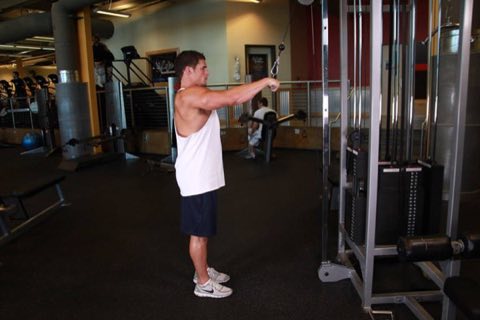
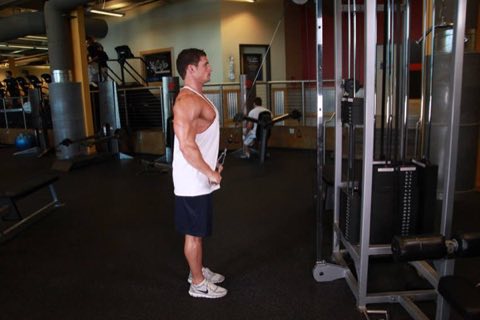
Your lats are the sole prime mover in a straight-arm pulldown. Pulling the bar down in an arc from overhead to your thighs, with your elbows almost locked, isolates the lats by taking the biceps mostly out of the movement.
Because there is no elbow bend to share the load, the angle of your torso and the tightness of your lats before you start each rep determine how much tension the lats actually feel through the movement.

Log Straight-Arm Pulldown in PR Streak
PR Streak's library has 873 exercises, each with photos and step-by-step instructions like this one. Log this move and see what you lifted last time right next to every set, with every PR caught automatically and a chart for every exercise.


How to do it
- You will start by grabbing the wide bar from the top pulley of a pulldown machine and using a wider than shoulder-width pronated (palms down) grip. Step backwards two feet or so.
- Bend your torso forward at the waist by around 30-degrees with your arms fully extended in front of you and a slight bend at the elbows. If your arms are not fully extended then you need to step a bit more backwards until they are. Once your arms are fully extended and your torso is slightly bent at the waist, tighten the lats and then you are ready to begin.
- While keeping the arms straight, pull the bar down by contracting the lats until your hands are next to the side of the thighs. Breathe out as you perform this step.
- While keeping the arms straight, go back to the starting position while breathing in.
- Repeat for the recommended amount of repetitions.
Form tips
- Keep your arms almost fully straight throughout; bending your elbows turns this into a triceps pushdown instead of a lat isolation move.
- Hinge your torso forward slightly and keep it still. The movement should come from your shoulders, not from swinging your hips or leaning back.
- Think about pulling with your elbows, not your hands, to keep tension on the lats instead of the forearms.
- Pause briefly when your hands reach your thighs to feel the lats fully contracted before returning.
Exercise details
| Equipment | Cable |
|---|---|
| Level | Beginner |
| Mechanic | Isolation |

Used by lifters following PPL, 5x5, upper/lower, and more.
Frequently Asked Questions
Does the straight-arm pulldown work the same muscles as a lat pulldown?
Mostly, yes. Both target the lats, but a straight-arm pulldown isolates them by keeping the elbows locked, while a regular lat pulldown also brings the biceps in to bend the elbow. Use the straight-arm version to feel the lats work without arm assistance.
What reps work best for lat isolation moves like this?
Since it is a single-joint, cable-based lift, higher reps tend to work well. The NSCA muscle-size range of 6-12 reps at a moderate load, or the endurance range of 12 or more reps at a lighter load, both suit an isolation exercise like this.
More lats exercises
Exercise instructions and photos come from the free-exercise-db library, public domain, the same library used inside the PR Streak app.
