Dumbbell Row: Muscles Worked and How to Do It
TL;DR
The dumbbell row works your middle back as the prime mover, squeezing your shoulder blades together as you pull. Your lats pull your upper arm down and back alongside it, your biceps bend your elbow through the row, and your shoulders help stabilize your arm and control the weight.
- Primary muscle:
- Middle back
- Secondary muscles:
- Biceps, Lats, Shoulders
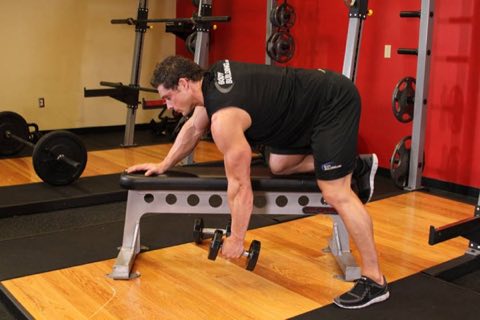
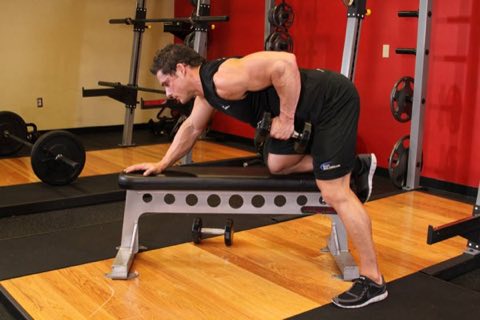
Muscles worked
Your middle back, the rhomboids and mid-traps between your shoulder blades, is the main mover in a dumbbell row, contracting to pull your shoulder blade back and in as the dumbbell reaches your torso. Your lats work alongside it, pulling your upper arm down and back through the same range.
Your biceps bend at the elbow to bring the weight up, and your shoulders (rear delts) help stabilize the arm and assist the pulling motion. Keeping your torso still while one arm works is part of the challenge, though the main training effect stays on your back and arms.

Log Dumbbell Row in PR Streak
PR Streak's library has 873 exercises, each with photos and step-by-step instructions like this one. Log this move and see what you lifted last time right next to every set, with every PR caught automatically and a chart for every exercise.


How to do it
- Choose a flat bench and place a dumbbell on each side of it.
- Place the right leg on top of the end of the bench, bend your torso forward from the waist until your upper body is parallel to the floor, and place your right hand on the other end of the bench for support.
- Use the left hand to pick up the dumbbell on the floor and hold the weight while keeping your lower back straight. The palm of the hand should be facing your torso. This will be your starting position.
- Pull the resistance straight up to the side of your chest, keeping your upper arm close to your side and keeping the torso stationary. Breathe out as you perform this step. Tip: Concentrate on squeezing the back muscles once you reach the full contracted position. Also, make sure that the force is performed with the back muscles and not the arms. Finally, the upper torso should remain stationary and only the arms should move. The forearms should do no other work except for holding the dumbbell; therefore do not try to pull the dumbbell up using the forearms.
- Lower the resistance straight down to the starting position. Breathe in as you perform this step.
- Repeat the movement for the specified amount of repetitions.
- Switch sides and repeat again with the other arm.
Form tips
- Keep your back flat and roughly parallel to the floor, not rounded.
- Pull your elbow back and slightly up, brushing your ribs, rather than out to the side.
- Let the dumbbell hang and stretch at the bottom of each rep.
- Squeeze your shoulder blade back at the top before lowering under control.
- Support your other hand on a bench to keep your torso stable and avoid twisting.
Exercise details
| Equipment | Dumbbell |
|---|---|
| Level | Beginner |
| Mechanic | Compound |

Used by lifters following PPL, 5x5, upper/lower, and more.
Frequently Asked Questions
Should I row with a rounded or flat back?
Keep your back flat, roughly parallel to the floor, with a neutral neck. A rounded back shifts stress onto your spine instead of your back muscles and raises your risk of strain, especially as the weight gets heavier. Bracing your core before you start each rep helps you hold that position.
How many reps of dumbbell rows build a bigger back?
For muscle size, work in the 6-12 rep range at 67-85% of your one-rep max, pausing briefly at the top of each pull. Heavier sets of 6 reps or fewer at 85% or more build raw pulling strength, which carries over to rows, chin-ups and deadlifts.
More middle back exercises
Exercise instructions and photos come from the free-exercise-db library, public domain, the same library used inside the PR Streak app.
