Neutral-Grip Pull-Up: Muscles Worked and How to Do It
TL;DR
The neutral-grip pull-up is a lat-dominant pulling exercise: your lats drive your body upward while the biceps bend the elbows, the middle back squeezes your shoulder blades together, and the shoulders help stabilize the movement. The parallel-grip handles are often easier on the shoulders than a wide overhand grip.
- Primary muscle:
- Lats
- Secondary muscles:
- Biceps, Middle back, Shoulders
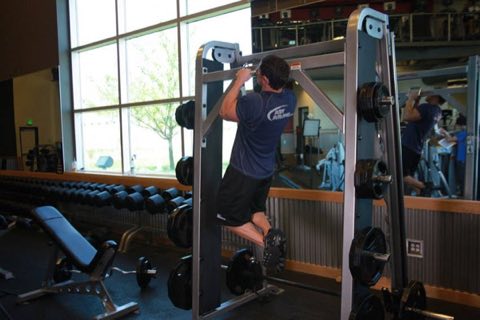
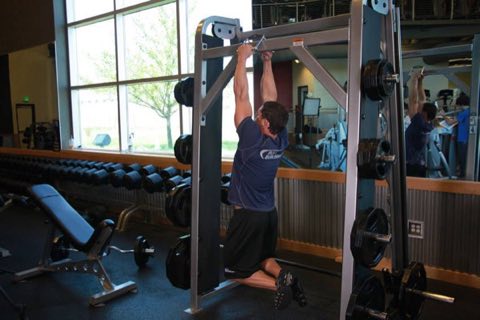
Muscles worked
Your lats (latissimus dorsi) are the main mover, pulling your elbows down and back to lift your body toward the bar. The neutral, palms-facing grip lets the lats work through a strong range of motion without twisting the shoulder joint.
The biceps assist by bending the elbows as you pull, which is why this grip tends to feel a bit easier on the arms than a wide pull-up. Your middle back muscles, the rhomboids and mid-traps, pull your shoulder blades together at the top of the rep, and the shoulders work to keep the joint stable and controlled throughout the pull.

Log Neutral-Grip Pull-Up in PR Streak
PR Streak's library has 873 exercises, each with photos and step-by-step instructions like this one. Log this move and see what you lifted last time right next to every set, with every PR caught automatically and a chart for every exercise.


How to do it
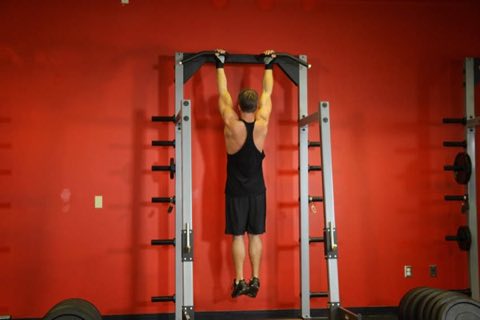
- Start by placing the middle of the V-bar in the middle of the pull-up bar (assuming that the pull-up station you are using does not have neutral grip handles). The V-Bar handles will be facing down so that you can hang from the pull-up bar through the use of the handles.
- Once you securely place the V-bar, take a hold of the bar from each side and hang from it. Stick your chest out and lean yourself back slightly in order to better engage the lats. This will be your starting position.
- Using your lats, pull your torso up while leaning your head back slightly so that you do not hit yourself with the chin-up bar. Continue until your chest nearly touches the V-bar. Exhale as you execute this motion.
- After a second hold on the contracted position, slowly lower your body back to the starting position as you breathe in.
- Repeat for the prescribed number of repetitions.
Form tips
- Start from a full hang with your shoulder blades relaxed, not shrugged up toward your ears.
- Pull your elbows down and back, not just up, to keep the lats doing the work.
- Drive your chest toward the handles instead of just lifting your chin over the bar.
- Lower yourself under control on the way down. Don't just drop from the top.
Exercise details
| Equipment | Bodyweight |
|---|---|
| Level | Beginner |
| Mechanic | Compound |

Used by lifters following PPL, 5x5, upper/lower, and more.
Frequently Asked Questions
Is a neutral-grip pull-up easier than a regular pull-up?
Many lifters find it a bit easier on the shoulders and elbows because the palms-facing position is a more natural joint angle. The lats still do most of the work either way, so the strength carryover between grips is high.
How many pull-ups should I aim for?
It depends on your goal. For strength, work up to sets of 6 reps or fewer by adding weight once bodyweight reps get easy. For muscle size, 6-12 controlled reps per set is a solid target, and 12 or more builds muscular endurance.
What should I do if I can't do a full pull-up yet?
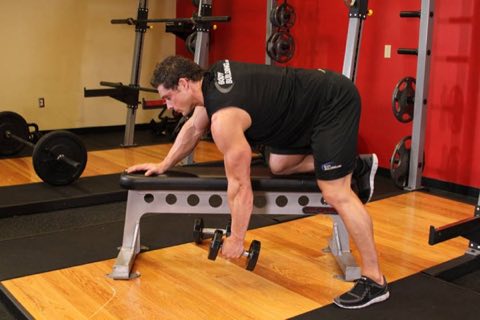
Build up with bent-over dumbbell rows to strengthen the same pulling muscles, and practice slow, controlled lowers from the top position. Both build the lat and back strength a full pull-up needs.
More lats exercises
Exercise instructions and photos come from the free-exercise-db library, public domain, the same library used inside the PR Streak app.
