Kettlebell Windmill: Muscles Worked and How to Do It
TL;DR
The kettlebell windmill is a rotational core move. Your abdominals control the side bend and resist rotation as you hinge toward the floor. Your glutes and hamstrings stretch and stabilize the standing leg, while your shoulders and triceps keep the kettlebell locked out overhead throughout.
- Primary muscle:
- Abdominals
- Secondary muscles:
- Glutes, Hamstrings, Shoulders, Triceps
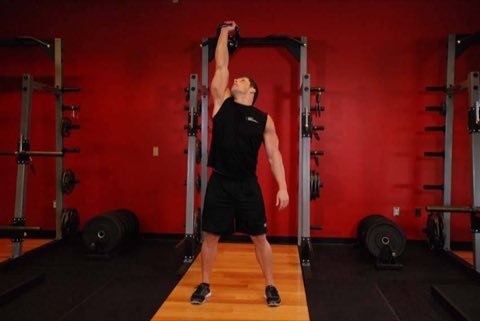
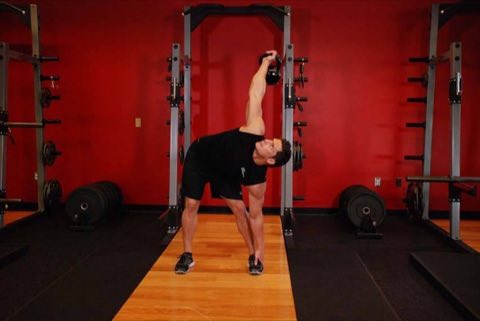
Muscles worked
Your abdominals, including the obliques along your sides, are the prime mover in the kettlebell windmill. They control the side bend as you hinge toward the floor and resist rotation so your hips and shoulders stay stacked instead of twisting open.
Your glutes and hamstrings on the standing leg work isometrically to stabilize the hip hinge, and the hamstring gets a stretch as you lean over that leg.
Your shoulders and triceps keep the kettlebell locked out directly overhead for the entire movement, which is as much a stability challenge for the shoulder as it is a core exercise.

Log Kettlebell Windmill in PR Streak
PR Streak's library has 873 exercises, each with photos and step-by-step instructions like this one. Log this move and see what you lifted last time right next to every set, with every PR caught automatically and a chart for every exercise.


How to do it
- Place a kettlebell in front of your lead foot and clean and press it overhead with your opposite arm. Clean the kettlebell to your shoulder by extending through the legs and hips as you pull the kettlebell towards your shoulders. Rotate your wrist as you do so, so that the palm faces forward. Press it overhead by extending the elbow.
- Keeping the kettlebell locked out at all times, push your butt out in the direction of the locked out kettlebell. Turn your feet out at a forty-five degree angle from the arm with the locked out kettlebell. Bending at the hip to one side, sticking your butt out, slowly lean until you can touch the floor with your free hand. Keep your eyes on the kettlebell that you hold over your head at all times.
- Pause for a second after reaching the ground and reverse the motion back to the starting position.
Form tips
- Keep your eyes on the kettlebell overhead the whole time so you notice if it drifts out of the locked-out position.
- Push your hips back and to the side as you hinge, rather than just bending forward at the waist.
- Start with a light kettlebell or no weight at all until the hip hinge and shoulder position feel natural.
- Keep a slight bend in the standing leg's knee instead of locking it out.
- Master the kettlebell swing hip hinge before layering on the windmill's rotation.
Exercise details
| Equipment | Kettlebell |
|---|---|
| Level | Intermediate |
| Mechanic | Compound |

Used by lifters following PPL, 5x5, upper/lower, and more.
Frequently Asked Questions
Is the kettlebell windmill a shoulder exercise or an ab exercise?
It trains both at once. Your abdominals and obliques do the rotational control work of the hinge, while your shoulder stays under constant tension holding the kettlebell locked out overhead, making this as much a shoulder stability drill as a core move.
How heavy should the kettlebell be for windmills?
Lighter than you would guess. Because the exercise demands shoulder stability and hip mobility more than raw strength, most lifters use a light kettlebell for 6-12 reps per side while they groove the pattern, adding load only once the position is solid.
More abdominals exercises
Exercise instructions and photos come from the free-exercise-db library, public domain, the same library used inside the PR Streak app.
