Russian Twist: Muscles Worked and How to Do It
TL;DR
The Russian twist works your abdominals, mainly the obliques that rotate your torso side to side, while your lower back muscles work isometrically to keep your spine stable through the twist. Done with control, it builds rotational core strength that carries over to throwing and change-of-direction movements.
- Primary muscle:
- Abdominals
- Secondary muscles:
- Lower back
Muscles worked
Your abdominals, especially the internal and external obliques, drive the rotation from side to side. They're the muscles doing the actual twisting, and slowing the movement down keeps the tension on them instead of letting momentum do the work.
Your lower back muscles work isometrically to keep your spine in a stable, neutral position while your torso rotates above your hips. Their job isn't to move, it's to resist unwanted extra motion in your spine as the twist happens.

Log Russian Twist in PR Streak
PR Streak's library has 873 exercises, each with photos and step-by-step instructions like this one. Log this move and see what you lifted last time right next to every set, with every PR caught automatically and a chart for every exercise.


How to do it
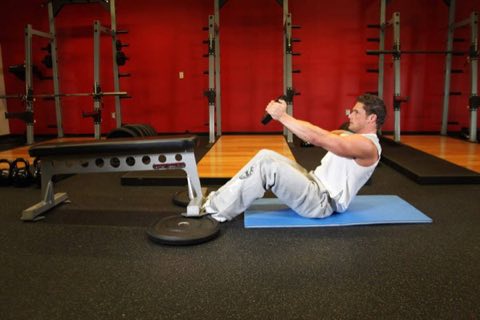
- Lie down on the floor placing your feet either under something that will not move or by having a partner hold them. Your legs should be bent at the knees.
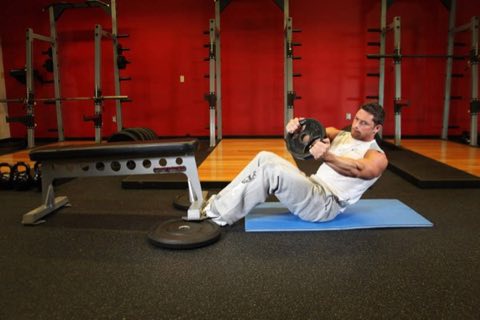
- Elevate your upper body so that it creates an imaginary V-shape with your thighs. Your arms should be fully extended in front of you perpendicular to your torso and with the hands clasped. This is the starting position.
- Twist your torso to the right side until your arms are parallel with the floor while breathing out.
- Hold the contraction for a second and move back to the starting position while breathing out. Now move to the opposite side performing the same techniques you applied to the right side.
- Repeat for the recommended amount of repetitions.
Form tips
- Rotate from your ribcage, not just by swinging your arms across your body.
- Keep your spine long instead of rounding your lower back to twist further.
- Tap or touch the floor lightly beside your hip rather than slamming a weight down.
- Lean back only as far as you can hold with a straight, stable spine.
- Move slowly on each side instead of using speed to cover for poor control.
Exercise details
| Equipment | Bodyweight |
|---|---|
| Level | Intermediate |
| Mechanic | Compound |

Used by lifters following PPL, 5x5, upper/lower, and more.
Frequently Asked Questions
Do Russian twists work my obliques or my lower back more?
The obliques do the actual rotating and are the main muscles trained here. Your lower back works isometrically to keep your spine stable while your torso twists, so it's more of a supporting stabilizer than the prime mover in this exercise.
Should I use a weight for Russian twists?
A light weight, like a plate or dumbbell, gives your obliques more to work against once bodyweight twists feel easy. Add weight gradually and keep your rotation controlled; if your lower back rounds or momentum takes over the twist, the weight is too heavy.
What pairs well with Russian twists for core training?
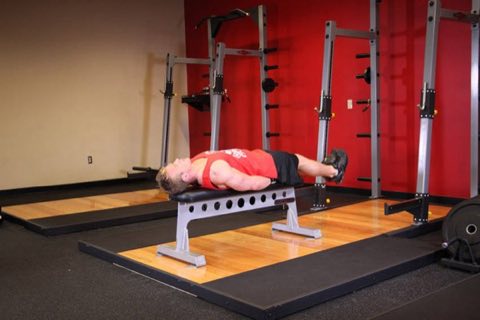
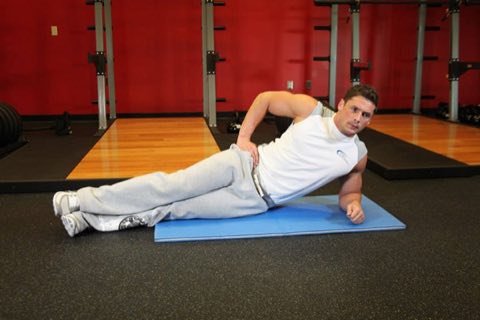
Combine rotational work like the Russian twist with anti-rotation holds, such as the side plank, and flexion work like the lying leg raise. Training rotation, anti-rotation and flexion together covers more of what your core does than twists alone.
More abdominals exercises
Exercise instructions and photos come from the free-exercise-db library, public domain, the same library used inside the PR Streak app.
