Side Plank: Muscles Worked and How to Do It
TL;DR
The side plank works your abdominals, mainly the obliques along your side, while your shoulders stabilize your body weight through the supporting arm. Holding a straight line from ankles to shoulders trains your core to resist sideways bending, a skill that carries over to almost every standing lift.
- Primary muscle:
- Abdominals
- Secondary muscles:
- Shoulders
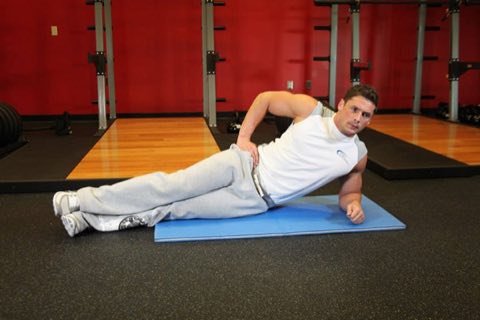
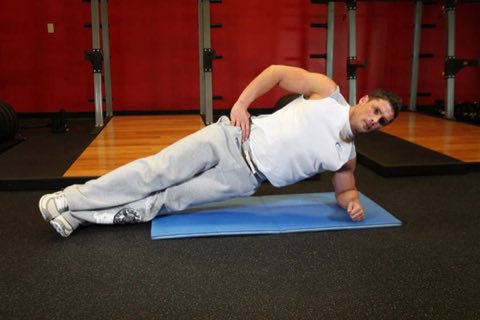
Muscles worked
Your abdominals, especially the obliques running along your sides, are the main muscles at work. Their job is to resist lateral flexion, keeping your hips from dropping toward the floor. Because the hold is isometric, your abs contract without moving, building the kind of core stability that protects your spine during squats, deadlifts and overhead presses.
Your shoulders support your upper body weight through the arm planted beneath you. The deltoid and the surrounding rotator cuff muscles work isometrically to keep your shoulder joint stable and stacked directly under your elbow or hand, which is also what keeps the position comfortable to hold.

Log Side Plank in PR Streak
PR Streak's library has 873 exercises, each with photos and step-by-step instructions like this one. Log this move and see what you lifted last time right next to every set, with every PR caught automatically and a chart for every exercise.


How to do it
Form tips
- Stack your shoulder directly over your elbow or wrist, not in front of it.
- Keep a straight line from your ankles to your shoulders; don't let your hips sag or pike up.
- Start on your forearm if a straight-arm side plank strains your wrist or shoulder.
- Breathe normally during the hold instead of bracing your breath.
- Build hold time in short increments rather than fighting for one long, shaky set.
Exercise details
| Equipment | Bodyweight |
|---|---|
| Level | Beginner |

Used by lifters following PPL, 5x5, upper/lower, and more.
Frequently Asked Questions
Does the side plank work the obliques more than a regular plank?
Yes. A standard plank challenges your abdominals mostly against forward and backward bending, while the side plank adds a sideways, or lateral, challenge that falls more on your obliques. Doing both directions gives your core a more complete training stimulus than either alone.
How long should I hold a side plank?
There's no single required hold time. Build up your hold length while your hips stay level and your line from ankles to shoulders stays straight. Once holding feels easy, add a small movement, like a hip dip or a raised top arm, instead of only chasing a longer static hold.
Should I pair the side plank with other core exercises?
Yes. The side plank trains anti-rotation and lateral stability, while a rotational move like the Russian twist trains controlled rotation. Together they cover more of what your core actually does during real lifts and sports movement than either exercise alone.
More abdominals exercises
Exercise instructions and photos come from the free-exercise-db library, public domain, the same library used inside the PR Streak app.
