Deadlift: Muscles Worked and How to Do It
TL;DR
The deadlift is a hip-hinge pull that works your lower back as the primary mover, driven by your glutes, hamstrings and quadriceps. Your lats, traps, middle back, forearms and calves brace your spine and grip the bar throughout, making it one of the most complete strength exercises you can do.
- Primary muscle:
- Lower back
- Secondary muscles:
- Calves, Forearms, Glutes, Hamstrings, Lats, Middle back, Quadriceps, Traps
Muscles worked
Your lower back (spinal erectors) works hardest in the deadlift, holding your spine in a strong, neutral position from the moment you grip the bar to full lockout. This is what lets the bigger hip and leg muscles do the actual lifting without your spine rounding under load.
Your glutes, hamstrings and quadriceps drive the lift itself. The hamstrings and glutes extend your hips as you stand up, while the quadriceps help straighten your knees off the floor and again at lockout.
Your lats and traps keep the bar pulled in close to your body and your shoulder blades set, your middle back helps hold your upper back rigid, and your forearms do the gripping. Your calves stay active for balance as you push through the floor.

Log Deadlift in PR Streak
PR Streak's library has 873 exercises, each with photos and step-by-step instructions like this one. Log this move and see what you lifted last time right next to every set, with every PR caught automatically and a chart for every exercise.


How to do it
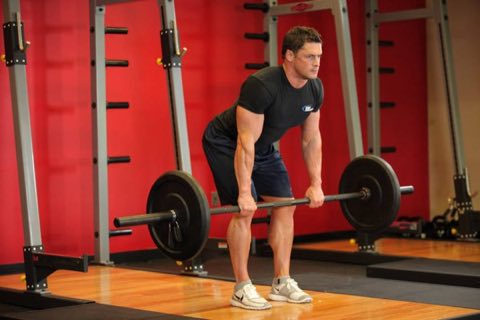
- Stand in front of a loaded barbell.
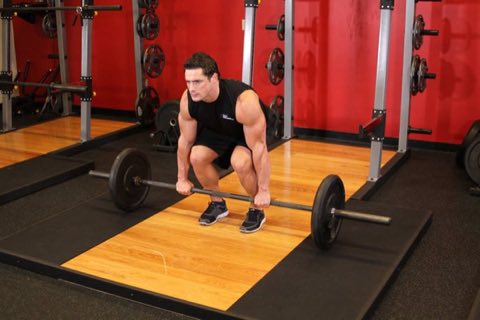
- While keeping the back as straight as possible, bend your knees, bend forward and grasp the bar using a medium (shoulder width) overhand grip. This will be the starting position of the exercise. Tip: If it is difficult to hold on to the bar with this grip, alternate your grip or use wrist straps.
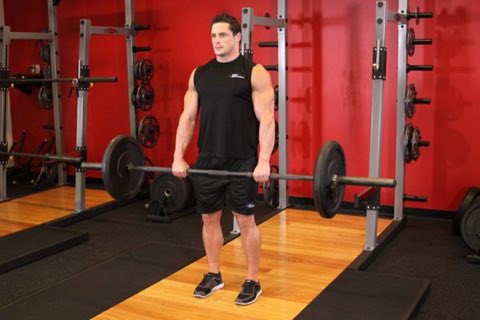
- While holding the bar, start the lift by pushing with your legs while simultaneously getting your torso to the upright position as you breathe out. In the upright position, stick your chest out and contract the back by bringing the shoulder blades back. Think of how the soldiers in the military look when they are in standing in attention.
- Go back to the starting position by bending at the knees while simultaneously leaning the torso forward at the waist while keeping the back straight. When the weights on the bar touch the floor you are back at the starting position and ready to perform another repetition.
- Perform the amount of repetitions prescribed in the program.
Form tips
- Set your feet hip-width apart with the bar over your midfoot before you grip it.
- Push your hips back and bend your knees until you can grip the bar with a flat, neutral back.
- Take the slack out of the bar, brace your core, then push the floor away with your legs to start the pull.
- Keep the bar in contact with your legs on the way up and the way down.
- Finish by squeezing your glutes at the top rather than leaning back.
Exercise details
| Equipment | Barbell |
|---|---|
| Level | Intermediate |
| Mechanic | Compound |

Used by lifters following PPL, 5x5, upper/lower, and more.
Frequently Asked Questions
What muscles does the deadlift work?
The deadlift is a hip-hinge exercise led by your lower back, glutes and hamstrings, with your quadriceps, lats, traps, middle back, forearms and calves all playing a supporting role. Few exercises train this much of your body in one lift.
Is the deadlift good for beginners?
Yes, with the right coaching. Start with lighter weight and focus on keeping a flat back and pushing through your heels before adding load. Many lifters build the hip-hinge pattern first with a trap bar or Romanian deadlift.
How much should I be able to deadlift?
It depends on your bodyweight, sex, age and training experience. Try an 1RM calculator from a recent working set to estimate your current deadlift max and track it over time.
More lower back exercises
Exercise instructions and photos come from the free-exercise-db library, public domain, the same library used inside the PR Streak app.
