Back Extension: Muscles Worked and How to Do It
TL;DR
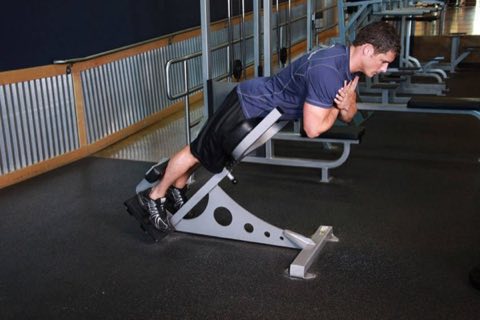
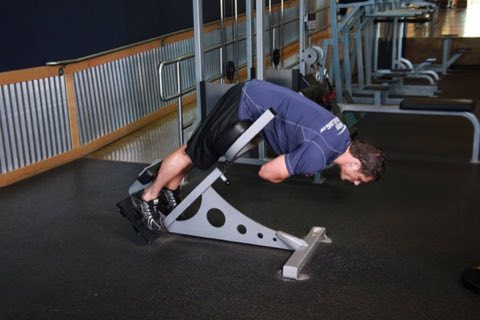
The back extension works your lower back as it holds your spine flat while you hinge forward and rise back up on a hyperextension bench. Your glutes and hamstrings extend your hip to raise your torso, making this as much a hip hinge exercise as a lower back one.
- Primary muscle:
- Lower back
- Secondary muscles:
- Glutes, Hamstrings
Muscles worked
Your lower back works isometrically through the back extension, holding your spine flat and straight as you hinge forward and rise back up, rather than rounding under the load. Your glutes and hamstrings do the actual work of extending your hip to lift your torso back to the top position.

Log Back Extension in PR Streak
PR Streak's library has 873 exercises, each with photos and step-by-step instructions like this one. Log this move and see what you lifted last time right next to every set, with every PR caught automatically and a chart for every exercise.


How to do it
- Lie face down on a hyperextension bench, tucking your ankles securely under the footpads.
- Adjust the upper pad if possible so your upper thighs lie flat across the wide pad, leaving enough room for you to bend at the waist without any restriction.
- With your body straight, cross your arms in front of you (my preference) or behind your head. This will be your starting position. Tip: You can also hold a weight plate for extra resistance in front of you under your crossed arms.
- Start bending forward slowly at the waist as far as you can while keeping your back flat. Inhale as you perform this movement. Keep moving forward until you feel a nice stretch on the hamstrings and you can no longer keep going without a rounding of the back. Tip: Never round the back as you perform this exercise. Also, some people can go farther than others. The key thing is that you go as far as your body allows you to without rounding the back.
- Slowly raise your torso back to the initial position as you inhale. Tip: Avoid the temptation to arch your back past a straight line. Also, do not swing the torso at any time in order to protect the back from injury.
- Repeat for the recommended amount of repetitions.
Form tips
- Hinge from your hips, not your lower back, keeping your spine flat throughout.
- Lower down only until you feel a stretch in your hamstrings, without rounding your back.
- Squeeze your glutes at the top rather than arching past a straight line.
- Add a weight plate held against your chest once bodyweight reps feel easy.
Exercise details
| Equipment | Other |
|---|---|
| Level | Beginner |
| Mechanic | Isolation |

Used by lifters following PPL, 5x5, upper/lower, and more.
Frequently Asked Questions
Does the back extension work the lower back or the glutes?
Both, but they play different roles. Your lower back holds your spine steady and flat, while your glutes and hamstrings do the actual hip extension that raises your torso. Think of it as a hip hinge with your lower back working to stabilize.
How many reps should I do for back extensions?
Bodyweight back extensions work well in the 12 reps or more range for muscular endurance, and adding a plate for resistance can bring you into the 6-12 rep range for muscle size. Pair it with a good morning for a standing hip hinge variation.
More lower back exercises
Exercise instructions and photos come from the free-exercise-db library, public domain, the same library used inside the PR Streak app.
