Close-Grip Lat Pulldown: Muscles Worked and How to Do It
TL;DR
The close-grip lat pulldown works your lats, which pull the bar down and back as your elbows drive toward your hips, while your biceps assist the pull and your middle back and shoulders help finish the movement. The close, often neutral grip pulls through a slightly different path than a wide grip.
- Primary muscle:
- Lats
- Secondary muscles:
- Biceps, Middle back, Shoulders
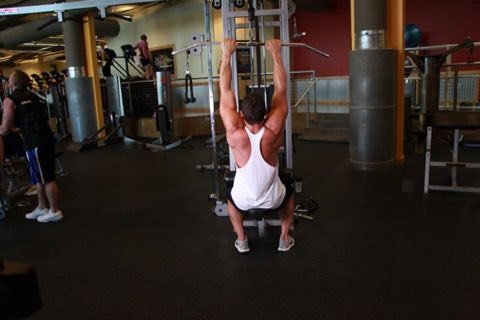
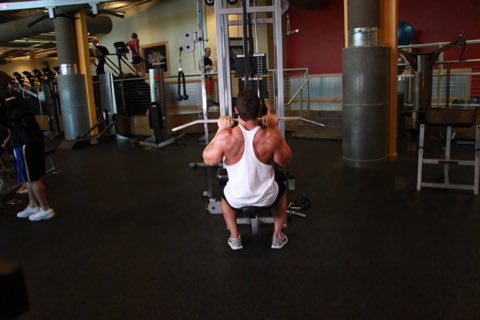
Muscles worked
Your lats are the prime mover, pulling your elbows down from an overhead position to your sides. The close grip lets your elbows travel closer to your torso, which many lifters feel as a stronger lat contraction than a wide grip.
Your biceps assist throughout the pull, especially bending your elbow through the second half of the movement, and they work harder here than they do on a wide-grip pulldown.
Your middle back helps pull your shoulder blades together and down as the bar reaches your chest, and your shoulders stabilize the joint and assist in pulling your upper arm down and back.

Log Close-Grip Lat Pulldown in PR Streak
PR Streak's library has 873 exercises, each with photos and step-by-step instructions like this one. Log this move and see what you lifted last time right next to every set, with every PR caught automatically and a chart for every exercise.


How to do it
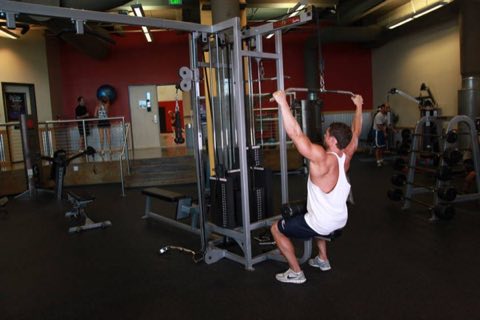
- Sit down on a pull-down machine with a wide bar attached to the top pulley. Make sure that you adjust the knee pad of the machine to fit your height. These pads will prevent your body from being raised by the resistance attached to the bar.
- Grab the bar with the palms facing forward using the prescribed grip. Note on grips: For a wide grip, your hands need to be spaced out at a distance wider than your shoulder width. For a medium grip, your hands need to be spaced out at a distance equal to your shoulder width and for a close grip at a distance smaller than your shoulder width.
- As you have both arms extended in front of you - while holding the bar at the chosen grip width - bring your torso back around 30 degrees or so while creating a curvature on your lower back and sticking your chest out. This is your starting position.
- As you breathe out, bring the bar down until it touches your upper chest by drawing the shoulders and the upper arms down and back. Tip: Concentrate on squeezing the back muscles once you reach the full contracted position. The upper torso should remain stationary (only the arms should move). The forearms should do no other work except for holding the bar; therefore do not try to pull the bar down using the forearms.
- After a second in the contracted position, while squeezing your shoulder blades together, slowly raise the bar back to the starting position when your arms are fully extended and the lats are fully stretched. Inhale during this portion of the movement.
- 6. Repeat this motion for the prescribed amount of repetitions.
Form tips
- Lead the pull with your elbows, driving them down toward your hips.
- Pull the bar to your upper chest, not behind your neck.
- Lean back only slightly; don't use your bodyweight to yank the bar down.
- Control the bar back up to a full stretch instead of letting it snap up.
- Keep your chest up and shoulder blades set before each pull.
Exercise details
| Equipment | Cable |
|---|---|
| Level | Beginner |
| Mechanic | Compound |

Used by lifters following PPL, 5x5, upper/lower, and more.
Frequently Asked Questions
Is the close-grip lat pulldown better for lats or biceps?
Your lats are still the prime mover, but the close, often neutral grip lets your biceps contribute more than they do on a wide-grip pulldown. If your biceps fatigue before your back does, that's normal here, not a sign you're doing the exercise wrong.
How is this different from a regular wide-grip pulldown?
A wide grip limits how far your elbows travel and biases the movement toward your outer lats, while the close grip lets your elbows pull further in toward your hips, adding more biceps involvement and, for many lifters, a stronger stretch and squeeze on the lats.
What's a good rep range for lat pulldowns?
6-12 reps per set at a weight that's challenging by the final reps fits the general muscle-building range for back work. Check your working weight against your best pull with the 1RM calculator if you want to plan around percentages.
More lats exercises
Exercise instructions and photos come from the free-exercise-db library, public domain, the same library used inside the PR Streak app.
