Cable Fly: Muscles Worked and How to Do It
TL;DR
The cable fly isolates your chest by moving your arms through a wide arc instead of bending your elbows. Your shoulders help control and position your arms throughout, but the constant tension the cables provide keeps the focus on your pecs from the stretch to the final squeeze.
- Primary muscle:
- Chest
- Secondary muscles:
- Shoulders
Muscles worked
Your chest is the target of the cable fly. Because your arms move in a wide arc rather than bending like a press, your pecs stay under tension through the entire range, from the deep stretch at your sides to the squeeze as your hands meet in front of you.
Your shoulders work throughout the movement to keep your arms positioned and control the arc, especially at the stretched end of the rep where the cables pull hardest on your joints.

Log Cable Fly in PR Streak
PR Streak's library has 873 exercises, each with photos and step-by-step instructions like this one. Log this move and see what you lifted last time right next to every set, with every PR caught automatically and a chart for every exercise.


How to do it
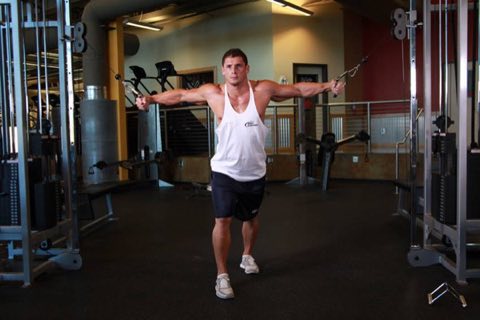
- To get yourself into the starting position, place the pulleys on a high position (above your head), select the resistance to be used and hold the pulleys in each hand.
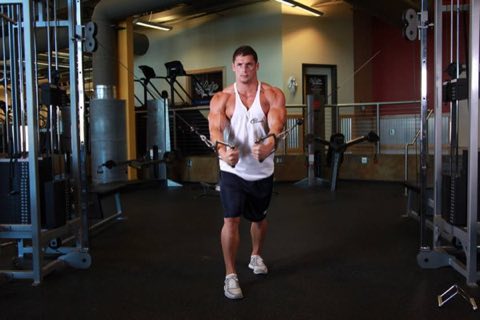
- Step forward in front of an imaginary straight line between both pulleys while pulling your arms together in front of you. Your torso should have a small forward bend from the waist. This will be your starting position.
- With a slight bend on your elbows in order to prevent stress at the biceps tendon, extend your arms to the side (straight out at both sides) in a wide arc until you feel a stretch on your chest. Breathe in as you perform this portion of the movement. Tip: Keep in mind that throughout the movement, the arms and torso should remain stationary; the movement should only occur at the shoulder joint.
- Return your arms back to the starting position as you breathe out. Make sure to use the same arc of motion used to lower the weights.
- Hold for a second at the starting position and repeat the movement for the prescribed amount of repetitions.
Form tips
- Keep a slight bend in your elbows through the whole set to protect your biceps tendon.
- Move only at your shoulder joint, keeping your torso and upper arms still.
- Stop the stretch once you feel it in your chest, not your shoulder joint.
- Bring your hands together in the same wide arc on the way back as you used going out.
Exercise details
| Equipment | Cable |
|---|---|
| Level | Beginner |
| Mechanic | Isolation |

Used by lifters following PPL, 5x5, upper/lower, and more.
Frequently Asked Questions
Is the cable fly better than a dumbbell fly?
Both isolate your chest the same way, but cables keep tension on the muscle even at the start and end of the rep, where dumbbells go slack. Either works well for 6-12 reps to build chest size alongside a pressing movement.
Should I do cable flies before or after bench press?
Do flies after a pressing movement like the bench press so your shoulders and triceps aren't pre-fatigued for the heavier lift. Save flies for the end of your chest session as a finishing isolation exercise.
More chest exercises
Exercise instructions and photos come from the free-exercise-db library, public domain, the same library used inside the PR Streak app.
