Dumbbell Pullover: Muscles Worked and How to Do It
TL;DR
The dumbbell pullover works your chest as the prime mover, drawing your arms from overhead back down toward your hips. Your lats assist heavily through the same arc, your shoulders control the weight overhead, and your triceps keep your elbows in a fixed, slight bend throughout the movement.
- Primary muscle:
- Chest
- Secondary muscles:
- Lats, Shoulders, Triceps
Muscles worked
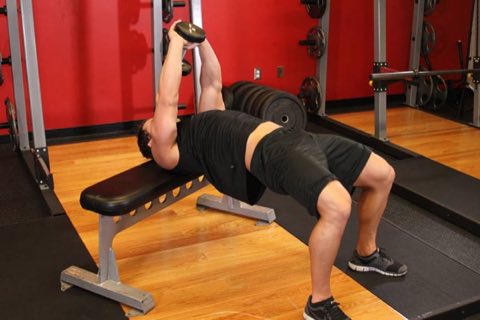
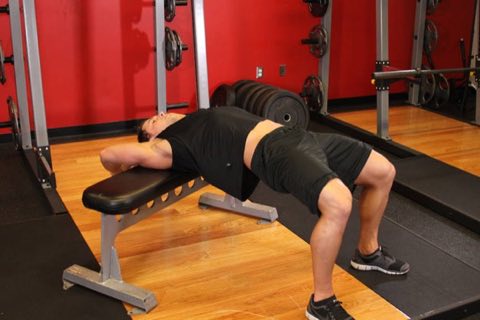
Your chest, particularly the portion that attaches near your armpit, works through a long arc in the pullover, pulling your arms from overhead back down toward your hips. Your lats work through nearly the same range, which is why the pullover is often debated as a chest or back exercise: it trains both.
Your shoulders stabilize the weight overhead, where the joint is in its most exposed position, so control matters more than load here. Your triceps stay in a fixed, slightly bent position to keep your elbows from moving, isolating the shoulder joint as the source of motion instead.

Log Dumbbell Pullover in PR Streak
PR Streak's library has 873 exercises, each with photos and step-by-step instructions like this one. Log this move and see what you lifted last time right next to every set, with every PR caught automatically and a chart for every exercise.


How to do it
- Place a dumbbell standing up on a flat bench.
- Ensuring that the dumbbell stays securely placed at the top of the bench, lie perpendicular to the bench (torso across it as in forming a cross) with only your shoulders lying on the surface. Hips should be below the bench and legs bent with feet firmly on the floor. The head will be off the bench as well.
- Grasp the dumbbell with both hands and hold it straight over your chest at arms length. Both palms should be pressing against the underside one of the sides of the dumbbell. This will be your starting position.
- Caution: Always ensure that the dumbbell used for this exercise is secure. Using a dumbbell with loose plates can result in the dumbbell falling apart and falling on your face.
- While keeping your arms straight, lower the weight slowly in an arc behind your head while breathing in until you feel a stretch on the chest.
- At that point, bring the dumbbell back to the starting position using the arc through which the weight was lowered and exhale as you perform this movement.
- Hold the weight on the initial position for a second and repeat the motion for the prescribed number of repetitions.
Form tips
- Keep a slight, fixed bend in your elbows throughout: don't turn it into a triceps extension.
- Lower the dumbbell only as far as your shoulders comfortably allow without arching your lower back.
- Support your hips and lower back on the bench, or bridge them up slightly for a deeper stretch.
- Move slowly through the bottom of the range where your shoulder is most exposed.
- Use a lighter weight than you'd expect: this is a stretch-focused movement, not a heavy press.
Exercise details
| Equipment | Dumbbell |
|---|---|
| Level | Intermediate |
| Mechanic | Compound |

Used by lifters following PPL, 5x5, upper/lower, and more.
Frequently Asked Questions
Is the pullover a chest or a back exercise?
It works both. Your chest and lats move through a similar arc as your arms travel from overhead to your hips, so the pullover trains muscles from both groups in one long stretch. Many lifters use it as accessory work alongside a bench press or row, not as a replacement for either.
How many reps of pullovers should I do?
Because it's a stretch-focused accessory movement, most lifters get good results in the 6-12 rep range at 67-85% of their one-rep max, prioritizing control over the overhead portion rather than chasing a heavier weight.
More chest exercises
Exercise instructions and photos come from the free-exercise-db library, public domain, the same library used inside the PR Streak app.
