Incline Dumbbell Press: Muscles Worked and How to Do It
TL;DR
The incline dumbbell press works your chest, with emphasis on the upper portion, while your shoulders help drive the press and your triceps lock out your elbows. The inclined bench angle changes the pressing line compared with a flat press, shifting more work toward your upper chest.
- Primary muscle:
- Chest
- Secondary muscles:
- Shoulders, Triceps
Muscles worked
Your chest, particularly the upper fibers of the pectoralis major, is the prime mover. The incline angle changes the direction your arms press in relative to your torso, putting more of the demand on the upper chest than a flat bench press does.
Your shoulders, mainly the front deltoid, assist heavily on an incline press, more so than on a flat bench. Your triceps finish the movement by straightening your elbows through the top portion of each rep.

Log Incline Dumbbell Press in PR Streak
PR Streak's library has 873 exercises, each with photos and step-by-step instructions like this one. Log this move and see what you lifted last time right next to every set, with every PR caught automatically and a chart for every exercise.


How to do it
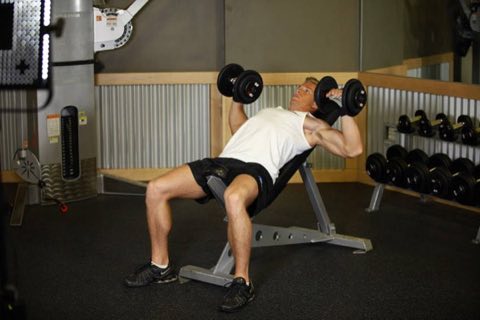
- Lie back on an incline bench with a dumbbell in each hand atop your thighs. The palms of your hands will be facing each other.
- Then, using your thighs to help push the dumbbells up, lift the dumbbells one at a time so that you can hold them at shoulder width.
- Once you have the dumbbells raised to shoulder width, rotate your wrists forward so that the palms of your hands are facing away from you. This will be your starting position.
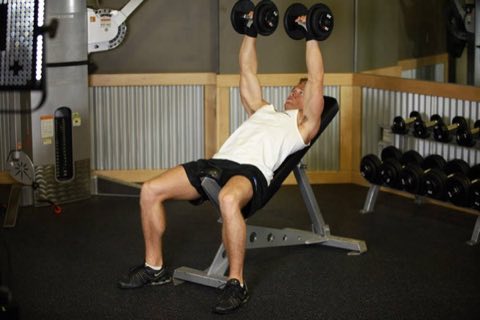
- Be sure to keep full control of the dumbbells at all times. Then breathe out and push the dumbbells up with your chest.
- Lock your arms at the top, hold for a second, and then start slowly lowering the weight. Tip Ideally, lowering the weights should take about twice as long as raising them.
- Repeat the movement for the prescribed amount of repetitions.
- When you are done, place the dumbbells back on your thighs and then on the floor. This is the safest manner to release the dumbbells.
Form tips
- Set the bench to a moderate incline; the steeper it gets, the more work shifts to your shoulders.
- Press the dumbbells up and slightly in toward each other at the top.
- Lower the dumbbells to the sides of your upper chest, not your collarbone.
- Keep your shoulder blades pulled back and down against the bench.
- Control the dumbbells on the way down instead of just letting them drop.
Exercise details
| Equipment | Dumbbell |
|---|---|
| Level | Beginner |
| Mechanic | Compound |

Used by lifters following PPL, 5x5, upper/lower, and more.
Frequently Asked Questions
What bench angle is best for the incline dumbbell press?
A moderate incline, clearly angled but well short of vertical, is the common range. Lower angles, closer to flat, keep more emphasis on your overall chest, while steeper angles shift more of the work onto your front shoulders. Test a few angles to find where you feel your chest working hardest.
Does the incline dumbbell press work the same muscles as the incline barbell press?
Yes, the same chest, shoulder and triceps pattern applies to both. Dumbbells let each arm move independently through a slightly larger range and require more shoulder stabilization, while a barbell typically lets you handle more total weight.
How does this compare to a flat bench press?
Both train your chest, shoulders and triceps, but the incline shifts more emphasis to your upper chest and front shoulders. Many lifters include both the incline dumbbell press and the close-grip bench press to hit the chest and triceps from different angles.
More chest exercises
Exercise instructions and photos come from the free-exercise-db library, public domain, the same library used inside the PR Streak app.
