Treadmill Walking: Muscles Worked and How to Do It
TL;DR
Treadmill walking is a low impact cardio movement that works your quadriceps and calves with every step. Your glutes and hamstrings extend your hip to push you forward, and raising the incline shifts more of that work onto your glutes and hamstrings the steeper the setting gets.
- Primary muscle:
- Quadriceps
- Secondary muscles:
- Calves, Glutes, Hamstrings
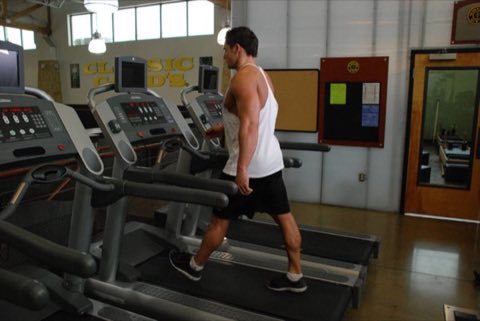
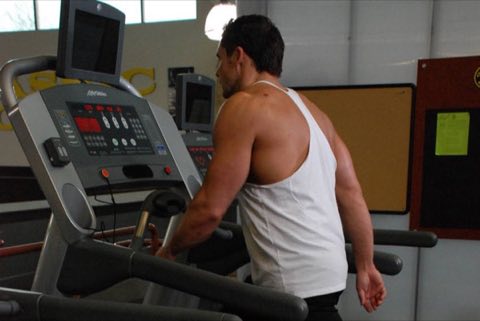
Muscles worked
Your quadriceps straighten your knee with each step, and your calves push you off the belt at the back of your stride and help control your foot as it lands. These two muscles do the bulk of the repetitive work over a long walk.
Your glutes and hamstrings extend your hip to drive you forward with each step, and they take on more of the load as you raise the incline, since a steeper grade asks your hips to do more of the pushing.

Log Treadmill Walking in PR Streak
PR Streak's library has 873 exercises, each with photos and step-by-step instructions like this one. Log this move and see what you lifted last time right next to every set, with every PR caught automatically and a chart for every exercise.


How to do it
- To begin, step onto the treadmill and select the desired option from the menu. Most treadmills have a manual setting, or you can select a program to run. Typically, you can enter your age and weight to estimate the amount of calories burned during exercise. Elevation can be adjusted to change the intensity of the workout.
- Treadmills offer convenience, cardiovascular benefits, and usually have less impact than walking outside. When walking, you should move at a moderate to fast pace, not a leisurely one. Being an activity of lower intensity, walking doesn't burn as many calories as some other activities, but still provides great benefit. A 150 lb person will burn about 175 calories walking 4 miles per hour for 30 minutes, compared to 450 calories running twice as fast. Maintain proper posture as you walk, and only hold onto the handles when necessary, such as when dismounting or checking your heart rate.
Form tips
- Keep an upright posture and only hold the handles when necessary.
- Walk at a pace brisk enough to raise your heart rate, not a slow stroll.
- Raise the incline gradually to shift more work onto your glutes and hamstrings.
- Land softly through the middle of your foot rather than stomping your heel.
Exercise details
| Equipment | Machine |
|---|---|
| Level | Beginner |

Used by lifters following PPL, 5x5, upper/lower, and more.
Frequently Asked Questions
Does incline walking work different muscles than flat walking?
The same muscles work either way: quadriceps, calves, glutes, and hamstrings. Raising the incline asks your glutes and hamstrings to do more of the pushing with each step, which is why incline walks feel tougher on your hips than flat ones.
Is treadmill walking enough exercise on its own?
It's a solid low impact cardio option that works your legs continuously, and it pairs well with strength training rather than replacing it. Try treadmill running once flat walking stops feeling challenging.
More quadriceps exercises
Exercise instructions and photos come from the free-exercise-db library, public domain, the same library used inside the PR Streak app.
