Step-Up: Muscles Worked and How to Do It
TL;DR
The step-up works your quadriceps, which straighten your knee as you drive up onto the box, while your glutes and hamstrings extend your hip and your calves stabilize your ankle. Training one leg at a time, it builds single-leg strength and balance that a two-legged squat doesn't.
- Primary muscle:
- Quadriceps
- Secondary muscles:
- Calves, Glutes, Hamstrings
Muscles worked
Your quadriceps straighten your knee to drive your body up onto the step, and they're loaded hardest through the middle of the movement, where your knee is most bent.
Your glutes and hamstrings extend your hip as you finish standing tall on the step, sharing the load with your quads rather than leaving it all to your knee. A taller step generally asks more of these hip muscles.
Your calves stabilize your ankle on the step and help push you the last few inches upright, especially if you rise up onto your toes at the top.

Log Step-Up in PR Streak
PR Streak's library has 873 exercises, each with photos and step-by-step instructions like this one. Log this move and see what you lifted last time right next to every set, with every PR caught automatically and a chart for every exercise.


How to do it
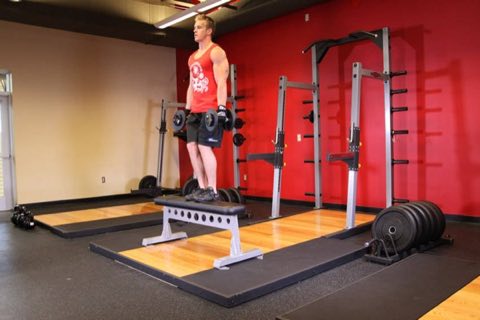
- Stand up straight while holding a dumbbell on each hand (palms facing the side of your legs).
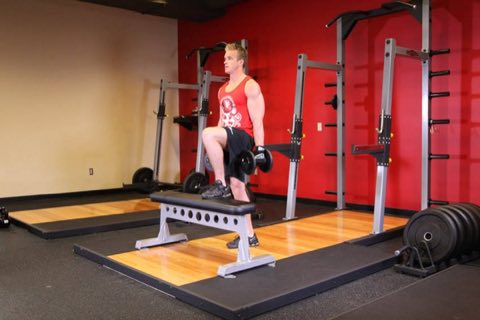
- Place the right foot on the elevated platform. Step on the platform by extending the hip and the knee of your right leg. Use the heel mainly to lift the rest of your body up and place the foot of the left leg on the platform as well. Breathe out as you execute the force required to come up.
- Step down with the left leg by flexing the hip and knee of the right leg as you inhale. Return to the original standing position by placing the right foot of to next to the left foot on the initial position.
- Repeat with the right leg for the recommended amount of repetitions and then perform with the left leg.
Form tips
- Choose a step height where your knee is at roughly a right angle at the bottom.
- Push through the whole foot on the step, not just your toes.
- Stand all the way up on the step instead of pushing off your trailing leg.
- Control the step back down instead of dropping or stepping off quickly.
- Keep your torso upright rather than leaning forward to build momentum.
Exercise details
| Equipment | Dumbbell |
|---|---|
| Level | Intermediate |
| Mechanic | Compound |

Used by lifters following PPL, 5x5, upper/lower, and more.
Frequently Asked Questions
Do step-ups work the glutes more than a squat?
Step-ups, especially onto a taller step, ask more of your glutes and hamstrings per leg because you're extending one hip through a longer range without a second leg sharing the load. Squats still let you load more total weight, so both have a place in training.
How high should my step-up box be?
A height where your knee bends to roughly a right angle at the bottom, often just below or at knee height, is a good starting point. A taller step increases the demand on your glutes and hamstrings, so raise the height gradually as your strength improves.
Should I use dumbbells for step-ups?
Holding a dumbbell in each hand, or one goblet-style at your chest, adds resistance once bodyweight step-ups feel easy. Pair heavier step-ups with a hip-dominant move like the glute bridge to round out your lower-body training.
More quadriceps exercises
Exercise instructions and photos come from the free-exercise-db library, public domain, the same library used inside the PR Streak app.
