StairMaster: Muscles Worked and How to Do It
TL;DR
Climbing the StairMaster is quad-dominant cardio: your quadriceps extend the knee to push each pedal down, while your glutes and hamstrings extend the hip and your calves drive through the ankle with every step. The repeated stepping motion trains lower-body endurance alongside your heart and lungs.
- Primary muscle:
- Quadriceps
- Secondary muscles:
- Calves, Glutes, Hamstrings
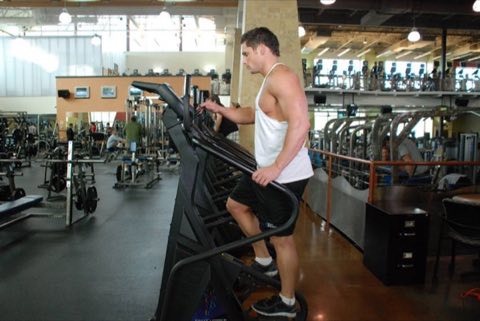
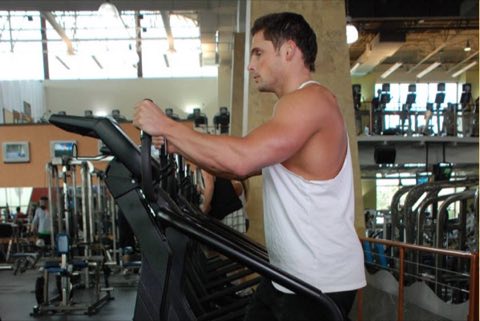
Muscles worked
Your quadriceps do most of the work, extending your knee to press each pedal down as you climb. Your glutes and hamstrings extend the hip on the same leg, helping drive your body upward with every step.
Your calves work through the ankle on each step, helping push off as one leg finishes its stride and the other takes over. Because the stepping motion repeats continuously, these muscles are trained more for endurance than for raw strength.

Log StairMaster in PR Streak
PR Streak's library has 873 exercises, each with photos and step-by-step instructions like this one. Log this move and see what you lifted last time right next to every set, with every PR caught automatically and a chart for every exercise.


How to do it
- To begin, step onto the stairmaster and select the desired option from the menu. You can choose a manual setting, or you can select a program to run. Typically, you can enter your age and weight to estimate the amount of calories burned during exercise.
- Pump your legs up and down in an established rhythm, driving the pedals down but not all the way to the floor. It is recommended that you maintain your grip on the handles so that you don't fall. The handles can be used to monitor your heart rate to help you stay at an appropriate intensity.
- Stairmasters offer convenience, cardiovascular benefits, and usually have less impact than running outside. They are typically much harder than other cardio equipment. A 150 lb person will typically burn over 300 calories in 30 minutes, compared to about 175 calories walking.
Form tips
- Stand tall and avoid leaning heavily on the handrails, which lets your legs skip some of the work.
- Take full steps rather than short, shallow ones so your legs get a complete range of motion.
- Keep a steady rhythm instead of stepping in short bursts that throw off your balance.
- Use the handrails lightly for balance only, not to support your bodyweight.
Exercise details
| Equipment | Machine |
|---|---|
| Level | Intermediate |

Used by lifters following PPL, 5x5, upper/lower, and more.
Frequently Asked Questions
Does the StairMaster work the glutes?
Yes. The glutes extend the hip on each step alongside the hamstrings, though the quadriceps do the largest share of the work by extending the knee to press the pedal down.
Is the StairMaster good for building leg muscle?
It's better suited to lower-body endurance and cardiovascular conditioning than to building size. The continuous, lighter-load stepping motion trains the quads, glutes, hamstrings, and calves for stamina rather than maximal strength.
What's a good bodyweight exercise to pair with StairMaster sessions?
Mountain climbers train a similar quad-driven, cardio-leaning pattern and are an easy way to add short conditioning bursts on days you don't have access to a machine.
More quadriceps exercises
Exercise instructions and photos come from the free-exercise-db library, public domain, the same library used inside the PR Streak app.
