Reverse Lunge: Muscles Worked and How to Do It
TL;DR
The reverse lunge works your quads as the prime mover, extending your front knee to stand back up. Your glutes and hamstrings extend your front hip alongside them, and your calves stabilize your ankle on the working leg through each single-leg rep.
- Primary muscle:
- Quadriceps
- Secondary muscles:
- Calves, Glutes, Hamstrings
Muscles worked
Your quads on the front leg do most of the work in a reverse lunge, straightening the knee to push you back to standing. Stepping backward instead of forward reduces the shear force on your front knee compared to a forward lunge, while still loading the same muscles.
Your glutes and hamstrings extend your front hip as you rise, with your glutes taking on more load the further forward your torso leans. Your calves work to stabilize your ankle on the standing leg, since a reverse lunge asks more of your balance than a two-legged squat.

Log Reverse Lunge in PR Streak
PR Streak's library has 873 exercises, each with photos and step-by-step instructions like this one. Log this move and see what you lifted last time right next to every set, with every PR caught automatically and a chart for every exercise.


How to do it
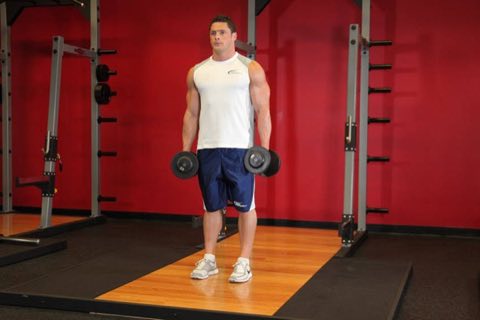
- Stand with your torso upright holding two dumbbells in your hands by your sides. This will be your starting position.
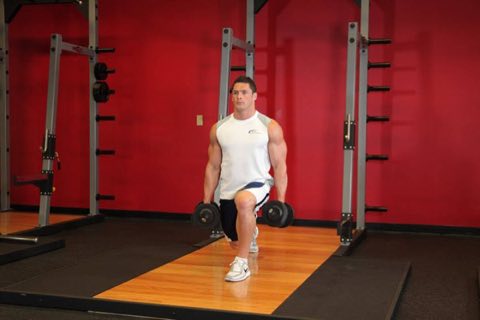
- Step backward with your right leg around two feet or so from the left foot and lower your upper body down, while keeping the torso upright and maintaining balance. Inhale as you go down. Tip: As in the other exercises, do not allow your knee to go forward beyond your toes as you come down, as this will put undue stress on the knee joint. Make sure that you keep your front shin perpendicular to the ground. Keep the torso upright during the lunge; flexible hip flexors are important. A long lunge emphasizes the Gluteus Maximus; a short lunge emphasizes Quadriceps.
- Push up and go back to the starting position as you exhale. Tip: Use the ball of your feet to push in order to accentuate the quadriceps. To focus on the glutes, press with your heels.
- Now repeat with the opposite leg.
Form tips
- Step back far enough that your front knee stays roughly over your ankle at the bottom.
- Lower your back knee toward the floor under control instead of dropping it.
- Keep most of your weight on your front foot rather than pushing off the back leg.
- Keep your torso upright for more quad emphasis, or lean forward slightly for more glute involvement.
- Push through your front heel to stand back up.
Exercise details
| Equipment | Dumbbell |
|---|---|
| Level | Intermediate |
| Mechanic | Compound |

Used by lifters following PPL, 5x5, upper/lower, and more.
Frequently Asked Questions
Is a reverse lunge easier on the knees than a forward lunge?
Yes, for most lifters. Stepping backward means your front knee doesn't travel as far past your toes, which reduces shear stress at the joint while still training the same quads, glutes and hamstrings. That makes it a common substitute when a forward lunge causes knee discomfort.
How many reps of reverse lunges should I do per leg?
For muscle size, work in the 6-12 rep range per leg at 67-85% of your one-rep max. Because balance is a limiting factor for many lifters, higher reps of 12 or more at lighter loads, like a goblet squat hold, also build solid muscular endurance.
More quadriceps exercises
Exercise instructions and photos come from the free-exercise-db library, public domain, the same library used inside the PR Streak app.
