Power Clean: Muscles Worked and How to Do It
TL;DR
The power clean is a full body pull. Your hamstrings and glutes drive the explosive hip extension that starts the bar moving, your traps and shoulders finish the pull and catch the bar, and your quadriceps, calves, back, forearms, and triceps all support the lift from floor to shoulders.
- Primary muscle:
- Hamstrings
- Secondary muscles:
- Calves, Forearms, Glutes, Lower back, Middle back, Quadriceps, Shoulders, Traps, Triceps
Muscles worked
Your hamstrings lead the power clean, driving the explosive hip extension that starts the bar moving fast off the floor. Your glutes and quadriceps work alongside them, straightening your hips and knees to accelerate the bar upward during the pull.
Your traps shrug the bar upward at the top of the pull, and your shoulders help guide it into the racked position on your front deltoids as you drop under it. Your middle back and lower back keep your torso rigid through the whole pull, so force transfers from your legs into the bar instead of leaking through a rounded spine.
Your forearms grip the bar under heavy, fast moving load from the first pull to the catch, and your calves help you rise onto your toes at full extension before you drop under the bar. Your triceps lock your elbows straight through the pull and help control the catch as you rack the bar on your shoulders.

Log Power Clean in PR Streak
PR Streak's library has 873 exercises, each with photos and step-by-step instructions like this one. Log this move and see what you lifted last time right next to every set, with every PR caught automatically and a chart for every exercise.


How to do it
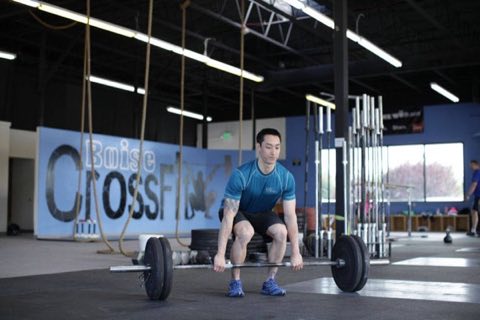
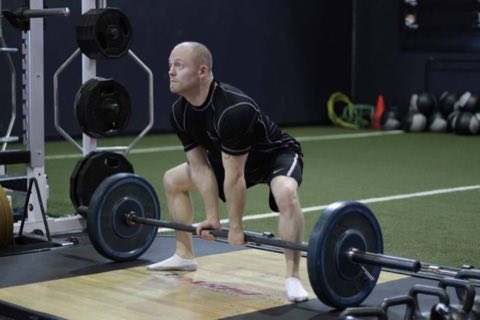
- Stand with your feet slightly wider than shoulder width apart and toes pointing out slightly.
- Squat down and grasp bar with a closed, pronated grip. Your hands should be slightly wider than shoulder width apart outside knees with elbows fully extended.
- Place the bar about 1 inch in front of your shins and over the balls of your feet.
- Your back should be flat or slightly arched, your chest held up and out and your shoulder blades should be retracted.
- Keep your head in a neutral position (in line with vertebral column and not tilted or rotated) with your eyes focused straight ahead. Inhale during this phase.
- Lift the bar from the floor by forcefully extending the hips and the knees as you exhale. Tip: The upper torso should maintain the same angle. Do not bend at the waist yet and do not let the hips rise before the shoulders (this would have the effect of pushing the glutes in the air and stretching the hamstrings.
- Keep elbows fully extended with the head in a neutral position and the shoulders over the bar.
- As the bar raises keep it as close to the shins as possible.
- As the bar passes the knees, thrust your hips forward and slightly bend the knees to avoid locking them. Tip: At this point your thighs should be against the bar.
- Keep the back flat or slightly arched, elbows fully extended and your head neutral. Tip: You will hold your breath until the next phase.
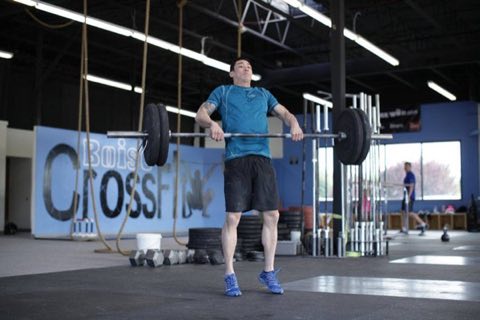
- Inhale and then forcefully and quickly extend your hips and knees and stand on your toes.
- Keep the bar as close to your body as possible. Tip: Your back should be flat with the elbows pointed out to the sides and your head in a neutral position. Also, keep your shoulders over the bar and arms straight as long as possible.
- When your lower body joints are fully extended, shrug the shoulders upward rapidly without letting the elbows flex yet. Exhale during this portion of the movement.
- As the shoulders reach their highest elevation flex your elbows to begin pulling your body under the bar.
- Continue to pull the arms as high and as long as possible. Tip: Due to the explosive nature of this phase, your torso will be erect or with an arched back, your head will be tilted back slightly and your feet may lose contact with the floor.
- After the lower body has fully extended and the bar reaches near maximal height, pull your body under the bar and rotate the arms around and under the bar.
- Simultaneously, flex the hips and knees into a quarter squat position.
- Once the arms are under the bar, inhale and then lift your elbows to position the upper arms parallel to the floor. Rack the bar across the front of your collar bones and front shoulder muscles.
- Catch the bar with an erect and tight torso, a neutral head position and flat feet. Exhale during this movement.
- Stand up by extending the hips and knees to a fully erect position.
- Lower the bar by gradually reducing the muscular tension of the arms to allow a controlled descent of the bar to the thighs. Inhale during this movement.
- Simultaneously flex the hips and knees to cushion the impact of the bar on the thighs.
- Squat down with the elbows fully extended until the bar touches the floor.
- Start over at Phase 1 and repeat for the recommended amount of repetitions.
Form tips
- Learn the movement with light weight or just the bar until the timing feels natural.
- Keep the bar close to your body throughout the pull, brushing your thighs.
- Extend your hips and knees forcefully before you shrug and pull under the bar.
- Practice catching the bar in a quarter squat with your elbows up and forward.
- Work with a coach or careful video review before adding heavy weight.
Exercise details
| Equipment | Barbell |
|---|---|
| Level | Intermediate |
| Mechanic | Compound |

Used by lifters following PPL, 5x5, upper/lower, and more.
Frequently Asked Questions
Is the power clean a good full body exercise?
Yes. It trains your hamstrings and glutes for hip power, your traps, shoulders, and back to pull and catch the bar, and your forearms, calves, quadriceps, and triceps to support the lift. Few exercises train this many muscles in a single explosive movement.
How many reps should I do for power cleans?
Power cleans are a technical, explosive lift, so keep sets to 6 reps or fewer at a weight in the 85% of 1RM or higher strength range, and rest fully between sets so speed doesn't break down. Confirm your working weight with the 1RM calculator first.
More hamstrings exercises
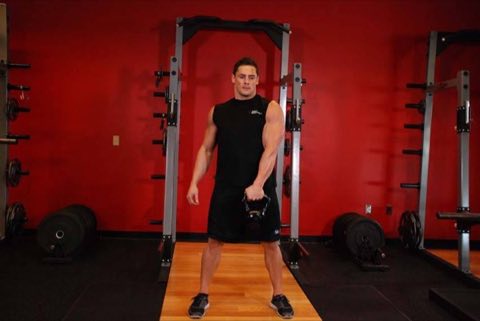
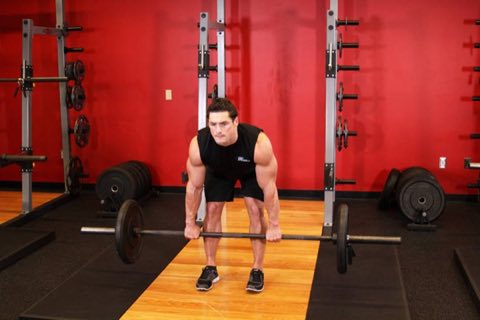
Exercise instructions and photos come from the free-exercise-db library, public domain, the same library used inside the PR Streak app.
