Leg Extension: Muscles Worked and How to Do It
TL;DR
The leg extension works your quads as the prime mover, straightening your knee against resistance from the machine's pad. Because it isolates knee extension without involving your hips, it's one of the most direct ways to fatigue your quads without your glutes or hamstrings sharing the load.
- Primary muscle:
- Quadriceps
Muscles worked
Your quads are the sole prime mover in a leg extension, contracting to straighten your knee and lift the pad. Unlike a squat, where your hips and knees move together, the leg extension isolates just the knee, which lets you target your quads directly.
Because your hips stay still throughout the movement, none of the load shifts to your glutes or hamstrings the way it can in a squat or lunge, making the leg extension a useful way to finish off your quads after compound leg work.

Log Leg Extension in PR Streak
PR Streak's library has 873 exercises, each with photos and step-by-step instructions like this one. Log this move and see what you lifted last time right next to every set, with every PR caught automatically and a chart for every exercise.


How to do it
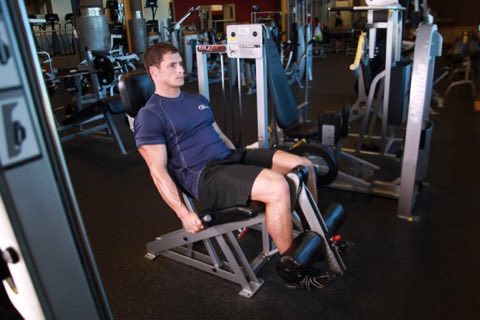
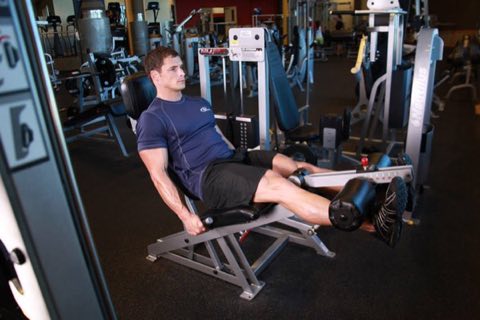
- For this exercise you will need to use a leg extension machine. First choose your weight and sit on the machine with your legs under the pad (feet pointed forward) and the hands holding the side bars. This will be your starting position. Tip: You will need to adjust the pad so that it falls on top of your lower leg (just above your feet). Also, make sure that your legs form a 90-degree angle between the lower and upper leg. If the angle is less than 90-degrees then that means the knee is over the toes which in turn creates undue stress at the knee joint. If the machine is designed that way, either look for another machine or just make sure that when you start executing the exercise you stop going down once you hit the 90-degree angle.
- Using your quadriceps, extend your legs to the maximum as you exhale. Ensure that the rest of the body remains stationary on the seat. Pause a second on the contracted position.
- Slowly lower the weight back to the original position as you inhale, ensuring that you do not go past the 90-degree angle limit.
- Repeat for the recommended amount of times.
Form tips
- Adjust the pad to sit just above your ankle, not on your shin bone.
- Extend your knee fully but avoid locking it out forcefully at the top.
- Lower the weight slowly instead of letting it drop.
- Keep your back against the pad and avoid arching to help lift the weight.
- Squeeze your quads briefly at the top of each rep.
Exercise details
| Equipment | Machine |
|---|---|
| Level | Beginner |
| Mechanic | Isolation |

Used by lifters following PPL, 5x5, upper/lower, and more.
Frequently Asked Questions
Is the leg extension bad for your knees?
For most healthy lifters, it's a safe, controlled way to load the knee joint through a fixed path. It becomes more of a concern with existing knee pain or very heavy loads locked out forcefully, so start light, move under control, and stop short of a hard lockout if you feel joint discomfort.
Should I do leg extensions before or after squats?
Most lifters do compound moves like squats first, while they're fresh and can handle the heaviest loads, then finish with leg extensions to fatigue the quads directly. Doing extensions first can pre-fatigue your quads and reduce how much weight you can squat safely.
More quadriceps exercises
Exercise instructions and photos come from the free-exercise-db library, public domain, the same library used inside the PR Streak app.
