Jump Squat: Muscles Worked and How to Do It
TL;DR
Jump squats train your quadriceps as the main driver of the explosive extension out of the squat. Your glutes and hamstrings add hip power alongside the quads, and your calves finish the movement by pushing you off the ground through your ankles.
- Primary muscle:
- Quadriceps
- Secondary muscles:
- Calves, Glutes, Hamstrings
Muscles worked
Your quadriceps are the primary mover in a jump squat. They extend your knees powerfully as you drive up out of the squat and leave the ground, then absorb the landing by bending again as you touch down.
Your glutes and hamstrings extend your hips at the same time your quads extend your knees, adding hip drive to the jump and helping control the depth of your landing.
Your calves add the final push through your ankles right before your feet leave the floor, and they help absorb impact through the ankle joint on landing.

Log Jump Squat in PR Streak
PR Streak's library has 873 exercises, each with photos and step-by-step instructions like this one. Log this move and see what you lifted last time right next to every set, with every PR caught automatically and a chart for every exercise.


How to do it
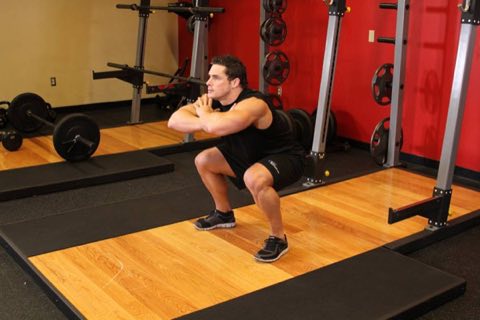
- Cross your arms over your chest.
- With your head up and your back straight, position your feet at shoulder width.
- Keeping your back straight and chest up, squat down as you inhale until your upper thighs are parallel, or lower, to the floor.
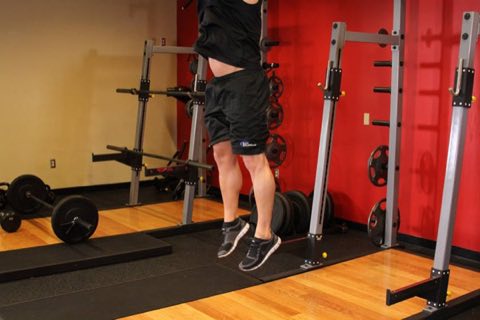
- Now pressing mainly with the ball of your feet, jump straight up in the air as high as possible, using the thighs like springs. Exhale during this portion of the movement.
- When you touch the floor again, immediately squat down and jump again.
- Repeat for the recommended amount of repetitions.
Form tips
- Squat to about the same depth each rep, roughly parallel, so your jump height stays consistent.
- Land softly with bent knees and reset before the next rep rather than bouncing straight back up.
- Swing your arms down and back on the way into the squat, then forward and up as you jump.
- Keep the reps low and explosive; slowing down defeats the point of a power exercise.
Exercise details
| Equipment | Bodyweight |
|---|---|
| Level | Intermediate |
| Mechanic | Compound |

Used by lifters following PPL, 5x5, upper/lower, and more.
Frequently Asked Questions
Are jump squats better than regular squats for building muscle?
No, they serve a different purpose. Jump squats train explosive power in your quadriceps, glutes and hamstrings, while a loaded regular squat builds more overall muscle size because you can progressively add weight. Many lifters use both.
How many jump squats should I do per set?
Keep sets short. Because jump squats are an explosive power move, 6 reps or fewer performed with full effort and good landing mechanics work better than high-rep sets, which tend to break down form as fatigue sets in.
More quadriceps exercises
Exercise instructions and photos come from the free-exercise-db library, public domain, the same library used inside the PR Streak app.
