Hip Thrust: Muscles Worked and How to Do It
TL;DR
The hip thrust is a glute-focused exercise: it works your glutes as the prime mover, with your hamstrings assisting hip extension and your calves stabilizing as you drive through your heels. Because you lock out at the top, it builds serious hip-extension strength and shapes the glutes better than most squat variations.
- Primary muscle:
- Glutes
- Secondary muscles:
- Calves, Hamstrings
Muscles worked
Your glutes are the prime mover in the hip thrust. As you drive your hips up and squeeze at the top, the gluteus maximus contracts through its full range of hip extension, more than in most squats or deadlifts, which makes this one of the most direct glute-builders in the gym.
Your hamstrings work alongside the glutes to extend the hip, especially in the last few inches of lockout. Your calves stay active the entire set: pressing your feet into the floor keeps your heels stable and gives your hips a solid base to drive from.

Log Hip Thrust in PR Streak
PR Streak's library has 873 exercises, each with photos and step-by-step instructions like this one. Log this move and see what you lifted last time right next to every set, with every PR caught automatically and a chart for every exercise.


How to do it
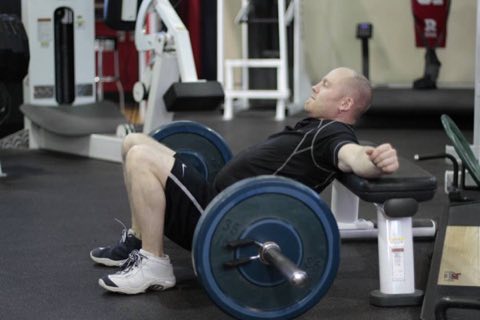
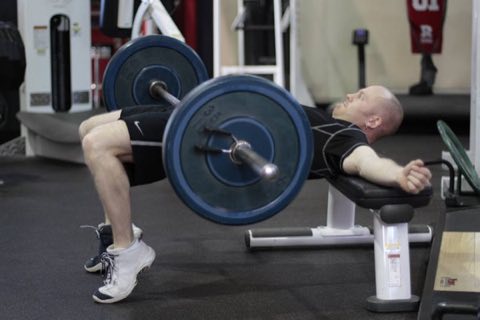
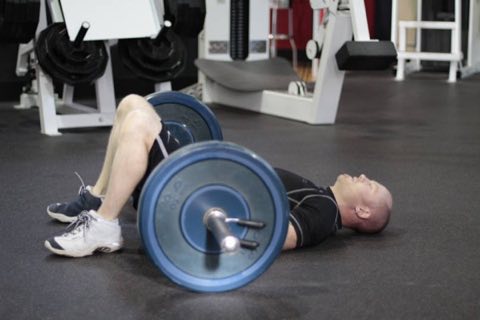
- Begin seated on the ground with a bench directly behind you. Have a loaded barbell over your legs. Using a fat bar or having a pad on the bar can greatly reduce the discomfort caused by this exercise.
- Roll the bar so that it is directly above your hips, and lean back against the bench so that your shoulder blades are near the top of it.
- Begin the movement by driving through your feet, extending your hips vertically through the bar. Your weight should be supported by your shoulder blades and your feet. Extend as far as possible, then reverse the motion to return to the starting position.
Form tips
- Set your upper back on the bench so the pad sits just below your shoulder blades, not on your neck.
- Plant your feet flat, shins vertical at the top of the movement, to keep tension in your glutes instead of your quads.
- Tuck your chin and keep your ribs down through the lift so you don't hyperextend your lower back at lockout.
- Pause and squeeze your glutes hard at the top of every rep.
- Start each rep with the bar or plate resting on the floor to reset tension, unless you're doing continuous reps.
Exercise details
| Equipment | Barbell |
|---|---|
| Level | Intermediate |
| Mechanic | Compound |

Used by lifters following PPL, 5x5, upper/lower, and more.
Frequently Asked Questions
Is the hip thrust better than squats for glutes?
The hip thrust puts more continuous tension on your glutes because it loads hip extension at its strongest point, while squats work your quads and glutes together through a longer range. Most lifters get the best glute results using both: squats for overall leg strength, hip thrusts for direct glute work.
How much weight should I use for hip thrusts?
It depends on your goal. For muscle size, use a load you can lift for 6-12 reps at 67-85% of your one-rep max; for pure hip-extension strength, drop to 6 reps or fewer at 85% or more. A 1RM calculator can help you find that starting number.
Why don't I feel hip thrusts in my glutes?
Usually it's foot position or depth. Bring your feet closer to your hips so your shins are vertical at the top, and stop the rep just before your lower back arches. Squeezing your glutes hard at lockout, rather than just raising the bar, is what shifts the tension there.
More glutes exercises
Exercise instructions and photos come from the free-exercise-db library, public domain, the same library used inside the PR Streak app.
