Dumbbell Squat: Muscles Worked and How to Do It
TL;DR
The dumbbell squat mainly works your quadriceps, with your glutes and hamstrings extending your hips as you stand up. Your calves and lower back stabilize the movement throughout. Holding the dumbbells at your sides makes it a simple, beginner friendly way to build real lower body strength.
- Primary muscle:
- Quadriceps
- Secondary muscles:
- Calves, Glutes, Hamstrings, Lower back
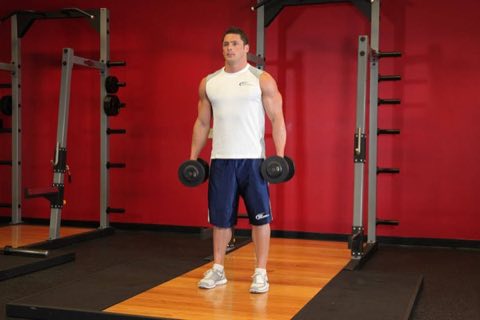
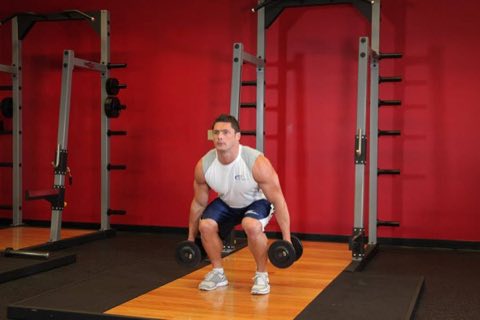
Muscles worked
Your quadriceps, the muscle group across the front of your thighs, do most of the work in the dumbbell squat. They straighten your knees as you drive up from the bottom of the squat, and they decide how much weight you can handle and how deep you can comfortably go.
Your glutes and hamstrings extend your hips alongside the quads, adding power as you finish each rep and stand tall. Your calves help you stay balanced on your feet through the descent, and your lower back holds your spine steady so the load moves safely down through your legs instead of through your back.

Log Dumbbell Squat in PR Streak
PR Streak's library has 873 exercises, each with photos and step-by-step instructions like this one. Log this move and see what you lifted last time right next to every set, with every PR caught automatically and a chart for every exercise.


How to do it
- Stand up straight while holding a dumbbell on each hand (palms facing the side of your legs).
- Position your legs using a shoulder width medium stance with the toes slightly pointed out. Keep your head up at all times as looking down will get you off balance and also maintain a straight back. This will be your starting position. Note: For the purposes of this discussion we will use the medium stance described above which targets overall development; however you can choose any of the three stances discussed in the foot stances section.
- Begin to slowly lower your torso by bending the knees as you maintain a straight posture with the head up. Continue down until your thighs are parallel to the floor. Tip: If you performed the exercise correctly, the front of the knees should make an imaginary straight line with the toes that is perpendicular to the front. If your knees are past that imaginary line (if they are past your toes) then you are placing undue stress on the knee and the exercise has been performed incorrectly.
- Begin to raise your torso as you exhale by pushing the floor with the heel of your foot mainly as you straighten the legs again and go back to the starting position.
- Repeat for the recommended amount of repetitions.
Form tips
- Hold the dumbbells at your sides, close to your legs, through the whole rep.
- Squat until your thighs are at least parallel to the floor, then drive up through your heels.
- Keep your head up and your chest tall to keep your lower back from rounding.
- Point your toes out slightly and keep your knees tracking in the same direction.
Exercise details
| Equipment | Dumbbell |
|---|---|
| Level | Beginner |
| Mechanic | Compound |

Used by lifters following PPL, 5x5, upper/lower, and more.
Frequently Asked Questions
Does the dumbbell squat work the same muscles as a barbell squat?
Yes. Both work your quadriceps as the prime mover, with your glutes, hamstrings, calves, and lower back assisting. Grip and arm fatigue tend to limit dumbbell squats before your legs do, which makes it a good option in the 6-12 rep range for building muscle.
How many reps should I do for a dumbbell squat?
Use 6-12 reps at a challenging weight if you're training for muscle size, or 12 or more lighter reps if you're building muscular endurance. Once dumbbells feel too light to add more, the barbell squat lets you keep loading the same muscles.
More quadriceps exercises
Exercise instructions and photos come from the free-exercise-db library, public domain, the same library used inside the PR Streak app.
