Strength vs Hypertrophy Training (2026): How to Choose
TL;DR
Strength vs hypertrophy training: pick strength training for a heavier one-rep max, using 1 to 6 reps at 85 to 100 percent of your max with 2 to 5 minutes of rest. Pick hypertrophy training for bigger muscles, using 6 to 12 reps and about 10 sets per muscle group each week. Many lifters blend both.
 PR Streak - Workout Tracker
The simple workout tracker that just works
- Log a set in seconds, with last time shown next to every set.
- Your history and PRs, caught automatically.
- Proven plans: Push Pull Legs, 5x5 Strength, Upper/Lower and more.
- A reminder to train, at the time you choose.
- Saved on your iPhone first, backed up, export anytime.
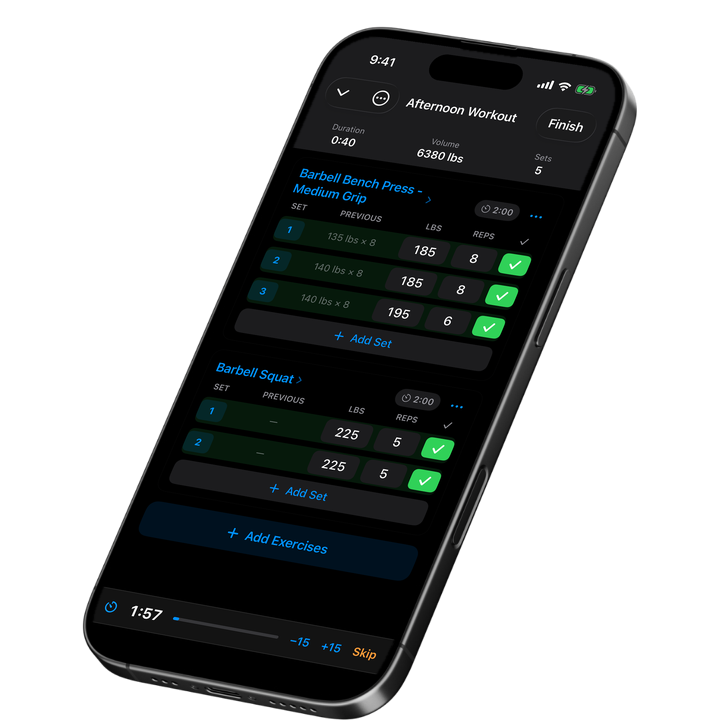

For lifters following PPL, 5x5, upper/lower, and more.
Strength vs Hypertrophy Training: Which Is Better in 2026?
Strength vs hypertrophy training in one line: choose strength training if your main goal is a heavier one-rep max; choose hypertrophy training if your main goal is bigger, more visible muscle.
Strength training builds your one-rep max with heavy loads of 85 to 100 percent of your max, done for 1 to 6 reps with 2 to 5 minutes of rest between sets. Hypertrophy training builds muscle size with moderate loads of 67 to 85 percent of your max, done for 6 to 12 reps with shorter rest of 30 to 90 seconds. Both styles use the same exercises and the same weekly gym visits, just organized differently.
Most lifters end up using both styles at different points in a training year. Understanding the difference in rep ranges, loads, rest and weekly volume makes it easier to pick the right focus for your current goal.
Strength vs Hypertrophy Training at a Glance
| Factor | Strength Training | Hypertrophy Training |
|---|---|---|
| Best For | Raising your one-rep max | Building muscle size |
| Rep Range | 1 to 6 reps | 6 to 12 reps |
| Load | 85 to 100 percent of 1RM | 67 to 85 percent of 1RM |
| Rest Between Sets | 2 to 5 minutes | 30 to 90 seconds |
| Weekly Volume | 2 to 3 sets per exercise | About 10 sets per muscle group |
| Primary Adaptation | Neural efficiency and max force | Muscle fiber growth |
| Who It Suits | Powerlifters, athletes chasing max strength | Bodybuilders, lifters chasing muscle size |
How PR Streak Fits Either Style
PR Streak is a workout tracker and gym log for iPhone that logs both styles the same way. The table changes to fit each exercise, so a 3-rep back squat and a 10-rep leg press both get the right fields at a glance.
Every personal record is caught automatically, and estimated 1RM blends two classic formulas, Epley and Brzycki, so a strength-focused lifter can watch their max climb over time on the 1RM calculator. Hypertrophy-focused lifters can see how many sets each muscle got this week, a direct read on weekly volume.
Answer a few questions and the AI coach builds a starting plan around your goal and your gear, whether that goal is a heavier squat or bigger arms. Start 5x5 Strength in one tap for a strength focus, or Push Pull Legs for a higher-volume hypertrophy split.
PR Streak - the simple workout tracker that just works.
- ✓See what you lifted last time next to every set.
- ✓Every PR tracked automatically, with clean progress charts.
- ✓Plus an AI coach that builds your plan around your goal and gear.
What Is Strength Training?
Strength training is resistance training built around lifting the heaviest weight you can for a small number of reps. The National Strength and Conditioning Association (NSCA) places the strength rep range at 1 to 6 reps, using loads of 85 to 100 percent of your one-rep max. Because the loads are so heavy, rest between sets runs 2 to 5 minutes, giving your nervous system time to recover before the next set.
Strength Training Key Traits
- Heavy compound lifts: Programs center on the squat, bench press, deadlift and overhead press.
- Low reps, long rest: 1 to 6 reps per set with 2 to 5 minutes of rest.
- Fewer sets, more focus: The ACSM's 2026 resistance training guidelines recommend 2 to 3 sets per exercise for strength, since each set demands near-maximal effort.
- Neural adaptation: Early strength gains often come from your nervous system learning to recruit more muscle fibers, not just muscle growth.
What Is Hypertrophy Training?
Hypertrophy training is resistance training built around accumulating enough work to grow muscle size. The NSCA places the hypertrophy rep range at 6 to 12 reps, using moderate to high loads of 67 to 85 percent of your one-rep max. Rest between sets is shorter, typically 30 to 90 seconds, which keeps more total work packed into a session.
Hypertrophy Training Key Traits
- Moderate loads, more reps: 6 to 12 reps per set at 67 to 85 percent of your max.
- Shorter rest: 30 to 90 seconds between sets keeps the session moving.
- Volume is the driver: The ACSM's 2026 guidelines point to about 10 sets per muscle group each week as a useful weekly target for muscle growth.
- Frequency matters: Both the ACSM guidelines and NSCA recommend training each major muscle group at least twice a week.
Head-to-Head Comparison
Rep Ranges and Load
Strength training uses 1 to 6 reps at 85 to 100 percent of your max, while hypertrophy training uses 6 to 12 reps at 67 to 85 percent. Heavier loads recruit more muscle fibers per rep, while moderate loads let you accumulate more total reps per session. A 2017 meta-analysis of 21 studies by Schoenfeld and colleagues, published in the Journal of Strength and Conditioning Research, found that when total training volume is matched and sets are taken close to failure, muscle growth is similar across a wide range of rep counts.
Best pick here: strength training if your goal is a number on the bar. Hypertrophy training if your goal is muscle size and you would rather do fewer total sets to get there.
Rest Between Sets
Strength training calls for 2 to 5 minutes of rest so you can lift near-maximal loads again with full recovery. Hypertrophy training uses shorter rest of 30 to 90 seconds, trading some load capacity for more total sets per hour in the gym. Longer rest lets you keep the bar heavier for longer, which matters more when every rep is close to your max.
Best pick here: strength training if you have the gym time for longer rest periods. Hypertrophy training if you want a shorter, denser session.
Weekly Training Volume
The ACSM's 2026 resistance training guidelines suggest 2 to 3 sets per exercise for strength work, since near-maximal loads limit how many quality sets you can complete. For hypertrophy, the same guidelines point to about 10 sets per muscle group each week as a useful target. A 2016 dose-response meta-analysis by Schoenfeld and colleagues, published in the Journal of Sports Sciences, found a graded relationship where higher weekly set counts produced greater muscle growth, up to a point.
Best pick here: hypertrophy training if you want a program built around hitting a weekly set target per muscle group.
Who Each Style Suits
Strength training suits powerlifters, athletes whose sport rewards raw force, and lifters who simply want to move heavier weight. Hypertrophy training suits bodybuilders, physique-focused lifters, and anyone whose main goal is visible muscle size rather than a max lift. Many general fitness lifters use a mix, running phases of each across a training year.
Best pick here: either, depending on whether your current goal is a number on the bar or a change in how you look and feel.
Combining Both Styles
Some programs blend the two by running heavier, lower-rep work early in a session and moderate-rep accessory work afterward. This lets a single workout target both a strength adaptation on the main lift and a hypertrophy adaptation on accessory movements. A push, pull, legs split is one common way to organize higher-volume hypertrophy work across a week.
Best pick here: a blended approach if you want progress on both your max lifts and your muscle size at the same time.
Who Should Choose Strength Training?
- You should choose strength training if your main goal is a heavier squat, bench or deadlift
- You should choose strength training if you compete in or train for powerlifting or a strength sport
- You should choose strength training if you prefer fewer, harder sets over longer rest periods
- You should choose strength training if you want to track your estimated 1RM climbing over time
Who Should Choose Hypertrophy Training?
- You should choose hypertrophy training if your main goal is muscle size rather than a max lift
- You should choose hypertrophy training if you want a denser session with shorter rest between sets
- You should choose hypertrophy training if you want to hit a weekly set target for each muscle group
- You should choose hypertrophy training if you enjoy training splits built around higher weekly volume
Frequently Asked Questions
What is the difference between strength training and hypertrophy training?
Strength training uses heavy loads of 85 to 100 percent of your one-rep max for 1 to 6 reps, with 2 to 5 minutes of rest, aimed at raising your max lift. Hypertrophy training uses moderate loads of 67 to 85 percent for 6 to 12 reps, with 30 to 90 seconds of rest, aimed at muscle size. Strength training prioritizes near-maximal effort on fewer sets, while hypertrophy training prioritizes total weekly volume across more sets. Many lifters use both styles across a training year, depending on their current goal.
How many reps should I do for strength versus hypertrophy?
For strength, the NSCA recommends 1 to 6 reps per set at 85 to 100 percent of your one-rep max. For hypertrophy, the recommended range is 6 to 12 reps at 67 to 85 percent of your max. Research suggests the exact rep count matters less than total training volume and how close each set comes to failure. Both rep ranges can build muscle when the total work is similar, but the heavier range builds strength faster.
Can I train for strength and hypertrophy in the same program?
Yes. Many programs schedule heavier, lower-rep sets on a main lift first, followed by moderate-rep accessory work for the same or supporting muscles. This lets one training block build toward both a heavier main lift and more overall muscle size. A split like push, pull, legs is a common way to fit higher-volume hypertrophy work around a few heavier strength-focused lifts each week.
How long should I rest between sets for strength training?
Strength training calls for 2 to 5 minutes of rest between sets, since near-maximal loads need full recovery before the next attempt. Shorter rest can leave you unable to hit the same weight for your next set. Hypertrophy training uses shorter rest of 30 to 90 seconds instead, trading some load capacity for more total sets in a session. Choose your rest length based on which adaptation you are training for that day.
Which is better for beginners, strength or hypertrophy training?
Beginners tend to respond well to either style, since new lifters gain both strength and muscle size from almost any structured program. Many beginner programs favor moderate rep ranges around 6 to 12 reps, which double as a hypertrophy range and are easier to learn with good form. As technique improves, adding lower-rep, heavier strength work becomes a natural next step. The right starting point usually comes down to whether a heavier lift or visible muscle change matters more to you right now.
Strength vs Hypertrophy Training: Which Should You Pick?
Strength vs hypertrophy training comes down to your current goal: a heavier max lift, or bigger, more visible muscle. Pick strength training for 1 to 6 reps at 85 to 100 percent of your max with long rest, or hypertrophy training for 6 to 12 reps and a weekly set target closer to 10 sets per muscle group.
Whichever style you pick, get PR Streak on the App Store to log every set, catch every PR and start a proven plan built around your goal. If you want more app options built around a strength focus, see our best strength training apps guide, or our best bodybuilding apps guide for a hypertrophy focus.