Strength Training for Runners: The Complete Guide (2026)
TL;DR
To do strength training for runners, add 2 to 3 sessions a week of squats, deadlifts, lunges and calf work alongside your running. A 2014 meta-analysis found strength training cut overuse injuries by almost half, and 6 to 20 weeks of training can improve running economy by 2 to 8 percent.


Used by lifters following PPL, 5x5, upper/lower, and more.
Strength Training for Runners
To do strength training for runners, add 2 to 3 sessions a week of squats, deadlifts, lunges and calf work alongside your running. Keep the loads heavy enough to challenge you, in the range of 70 to 90 percent of your one-rep max, and give your legs at least a day to recover before a hard run. A 2014 meta-analysis in the British Journal of Sports Medicine, covering 25 trials and more than 26,000 participants, found strength training cut overuse injuries by almost half.
Strength Training for Runners: Quick Steps
To add strength training as a runner, lift 2 to 3 times a week, focus on compound lower-body lifts, and log your sessions separately from your runs.
- Pick 2 to 3 strength days a week that do not fall right before a hard run
- Focus on compound lower-body lifts: squats, deadlifts, lunges and calf raises
- Load the bar heavy enough to feel challenging, not just a light warm-up
- Log your sets so you know when to add weight or reps
- Keep your run app for tracking runs, and a lifting log for the gym part
Most runners either skip the weight room entirely or bolt on a random routine with no real load. A short, focused strength session, tracked the same way you track your splits, closes that gap.
PR Streak - the workout tracker that coaches you.
- ✓An AI coach that builds your plan around your gear & goals.
- ✓Hands-free voice logging, plus progress, est. 1RM & PRs.
- ✓Built so you never lose a workout. Switch from Strong or Hevy in minutes.
Why Should Runners Strength Train?
Strength training reduces injury risk and can make you a more efficient runner. A 2014 meta-analysis in the British Journal of Sports Medicine, covering 25 trials and more than 26,000 participants, found that strength training cut overuse injuries by almost half compared to running alone.
On the performance side, a systematic review of controlled trials found that 6 to 20 weeks of strength training improved running economy by 2 to 8 percent, mainly through heavy compound lower-body lifts like the back squat and Romanian deadlift. Better running economy means using less energy at the same pace.
How Many Days a Week Should Runners Strength Train?
Most research points to 2 to 3 strength sessions a week as the sweet spot for runners. That is enough volume to build and keep strength without eating into the recovery you need for your running.
Spread your strength days so they do not land the day before a hard run or a long run. A common pattern is lifting right after an easy run, or on a day with no run at all, so your legs have time to recover before your next key session.
What Exercises Should Runners Include?
Runners get the most benefit from a small number of compound lower-body lifts done heavy, rather than a long list of isolation exercises. Squats, deadlifts, lunges and heavy calf work all have research support for improving running economy.
Research on this topic has used loads in the range of 70 to 90 percent of one-rep max, with 2 to 4 sets per exercise. A simple two-day template covers most of what a runner needs without turning into a second full workout program.
| Day | Exercise | Sets | Reps | Rest |
|---|---|---|---|---|
| Day 1 | Back squat | 3 | 5 | 2 to 3 min |
| Day 1 | Romanian deadlift | 3 | 6 to 8 | 2 min |
| Day 1 | Standing calf raise | 3 | 10 to 12 | 90 sec |
| Day 2 | Walking lunge | 3 | 8 per leg | 90 sec |
| Day 2 | Single-leg Romanian deadlift | 3 | 8 per leg | 90 sec |
| Day 2 | Seated calf raise | 3 | 12 to 15 | 60 sec |
You can build this exact split as your own routine in PR Streak, with your own rep ranges and rest times, and save it once you have it dialed in for your training block.
How Do You Track Strength Training Progress as a Runner?
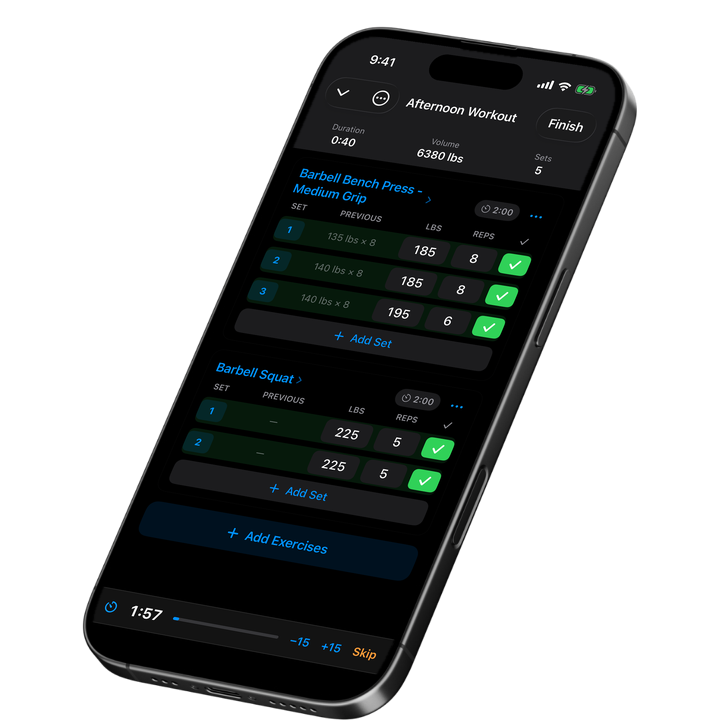
Track your strength sessions the same way you would track any lifting program: log every set, watch your working weight over time, and let the app catch your personal records for you. PR Streak shows what you lifted last time right next to every set, and every PR is caught automatically, including estimated 1RM.
Because strength days are often squeezed in around runs, fast logging matters. Voice logging lets you say a set out loud, like "three sets of eight at one thirty five," and PR Streak logs it between sets, so a strength session does not turn into a long phone session too.
What Should You Look for in an App to Track Strength Training as a Runner?
Look for an app that lets you build a custom routine around a small number of compound lifts, rather than one built only around bodybuilding splits. You also want fast logging, since strength days are often squeezed between runs and the rest of your day.
PR Streak lets you build your own routines with your own rep ranges and rest times, add your own exercises, and save any workout as a routine once you land on a version that works. It also tracks estimated 1RM automatically, so you can see your strength trending up without extra math.
How the Best Workout Apps Compare for Runners' Strength Training
Runners need a place to log lifting sessions that stays out of the way of their running app. Here is how a few common options compare.
| Tool | Best For | How It Helps with Strength Training for Runners |
|---|---|---|
| PR Streak | Fast logging on limited gym time | Last-time numbers and voice logging keep strength days short |
| Hevy | A big exercise library | Large database covers squats, deadlifts and lunge variations |
| Paper notebook | No setup at all | Free, but no automatic PR or 1RM tracking |
| Strava | Tracking your runs | Best for pace, distance and route data on running days |
For runners, PR Streak is a great fit because it logs strength sessions fast between sets and catches every PR, including estimated 1RM, without slowing down a short gym visit.
How to Get Started with Strength Training as a Runner
- Pick your 2 to 3 strength days: Choose days that do not sit right before a hard run or a long run, so your legs are fresh for both.
- Build a simple routine: Set up a routine in PR Streak with a small set of compound lifts, such as squats, deadlifts, lunges and calf raises, with your own rep ranges and rest times.
- Log by voice if your hands are full: Say your set out loud between exercises, like "three sets of eight at one thirty five," and PR Streak logs it for you.
- Track your progress over time: Watch your working weight and estimated 1RM trend upward, and let the AI coach give you a next-set suggestion with a short reason why.
Frequently Asked Questions
How should runners do strength training?
Runners should strength train 2 to 3 times a week, using compound lower-body lifts like squats, deadlifts and lunges loaded heavy enough to be challenging. A 2014 meta-analysis in the British Journal of Sports Medicine found strength training cut overuse injuries by almost half, and research shows 6 to 20 weeks of training can improve running economy by 2 to 8 percent.
How many days a week should runners strength train?
Most research points to 2 to 3 strength sessions a week for runners. That is enough to build and maintain strength without cutting into the recovery your running schedule needs. Spread those sessions so they do not land the day before a hard run or a long run.
What is the best app to track strength training for runners?
PR Streak is a strong pick for runners tracking strength training. It shows what you lifted last time right next to every set, lets you build a custom routine around a small number of compound lifts, and catches every PR automatically, including estimated 1RM, so a busy strength day does not need extra math.
Do I need to lift heavy as a runner?
Research on running economy has generally used loads in the range of 70 to 90 percent of one-rep max for 2 to 4 sets per exercise. Lighter loads can still build some strength, but the studies showing improved running economy and reduced injury risk mostly used heavier compound lifts rather than light, high-rep training.
Can strength training make me a faster runner?
It can help. A systematic review found that 6 to 20 weeks of strength training improved running economy, meaning runners used less energy at the same pace, by 2 to 8 percent. That effect comes mainly from heavy compound lower-body lifts like the back squat and Romanian deadlift, not from cardio-style circuit training.
Will strength training interfere with my running?
Not if it is spaced out sensibly. Keep hard lifting days away from your hardest running days, and give your legs time to recover between the two. Many runners lift right after an easy run or on a day with no run at all, which keeps both types of training effective without one working against the other.
Strength Training for Runners: The Short Version
Strength training for runners means 2 to 3 focused sessions a week built around heavy compound lower-body lifts like squats, deadlifts and lunges. The research is strong: a 2014 meta-analysis found it cut overuse injuries by almost half, and studies show it can improve running economy by 2 to 8 percent over 6 to 20 weeks.
Keep your run app for tracking runs, and use PR Streak for the gym part: fast logging, automatic PRs and estimated 1RM, and a custom routine you build once and reuse every week. Get PR Streak on the App Store and start logging your strength sessions in minutes.
If you want a broader set of programs to build from, see our best strength training apps guide and our best bodybuilding apps roundup for higher-volume splits.
📱 Built for iOS
