Free Weights vs Machines (2026): Which to Choose
TL;DR
Free weights vs machines: pick free weights for more stabilizer muscle activation, since one 2022 study found 17 to 59 percent higher core activity in free-weight squats. Pick machines to lift heavier safely and isolate one muscle, since a leg press allows loads up to 54 percent higher than a free-weight squat. Most lifters combine both.
 PR Streak - Workout Tracker
The simple workout tracker that just works
- Log a set in seconds, with last time shown next to every set.
- Your history and PRs, caught automatically.
- Proven plans: Push Pull Legs, 5x5 Strength, Upper/Lower and more.
- A reminder to train, at the time you choose.
- Saved on your iPhone first, backed up, export anytime.
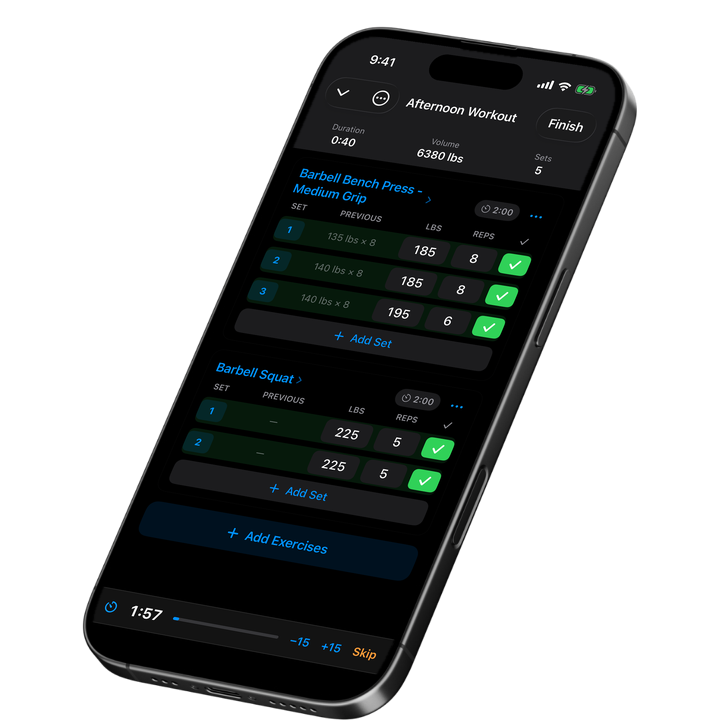

For lifters following PPL, 5x5, upper/lower, and more.
Free Weights vs Machines: Which Is Better in 2026?
Free weights vs machines in one line: choose free weights if you want more stabilizer muscle activation and functional strength; choose machines if you want to lift heavier safely and isolate a single muscle.
Free weights vs machines comes down to how each one balances your training. A 2022 study in the Journal of Strength and Conditioning Research found free-weight and Smith machine squats produced 17 to 59 percent higher core muscle activity than a leg press machine, which lets lifters load up to 54 percent more weight. Machines guide the movement path for you, while free weights ask your whole body to stabilize the load.
Both build real strength and muscle, and most gyms and home setups mix the two. The right split between them depends on your experience level, your goals and how much time you have to learn new movements.
Free Weights vs Machines at a Glance
| Factor | Free Weights | Machines |
|---|---|---|
| Best For | Stabilizer strength and functional carryover | Heavier, safer isolation of one muscle |
| Muscle Growth | Comparable to machines when volume is equal | Comparable to free weights when volume is equal |
| Load Capacity | Limited by balance and technique | Higher loads possible per set |
| Stabilizer Activation | 17 to 59 percent higher core activity in one study | Lower, since the machine guides the path |
| Learning Curve | Longer, technique-dependent | Shorter, guided movement path |
| Injury Risk Factors | Higher if form breaks down under load | Lower entry risk, fixed movement path |
| Who It Suits | Lifters wanting balance, coordination and carryover | Beginners and lifters isolating a muscle safely |
How PR Streak Fits Either Style
PR Streak is a workout tracker and gym log for iPhone that logs free weights and machines the same way. Log lifts, pull-ups, planks, carries and cardio, and the table changes to fit each exercise, so a barbell squat and a leg press both get the right fields.
Every personal record is caught automatically on both, and estimated 1RM blends two classic formulas, Epley and Brzycki, so you can watch a free-weight squat and a leg press climb side by side on the 1RM calculator. PR Streak's 873-exercise library covers free-weight, machine, and bodyweight movements, each with photos and step-by-step instructions.
PR Streak - the simple workout tracker that just works.
- ✓See what you lifted last time next to every set.
- ✓Every PR tracked automatically, with clean progress charts.
- ✓Plus an AI coach that builds your plan around your goal and gear.
What Is Free Weight Training?
Free weight training uses barbells, dumbbells and kettlebells, where you control the full path of the movement yourself. Because nothing guides the bar, your body recruits stabilizer muscles across your core, hips and shoulders to keep the load balanced. A 2022 study by Saeterbakken and colleagues, published in the Journal of Strength and Conditioning Research, found free-weight squats produced 17 to 59 percent higher core muscle activity than a leg press machine.
Free Weight Training Key Traits
- Full stabilization demand: Your core and stabilizer muscles work throughout the lift, not just the target muscle.
- Functional carryover: Balancing a load under your own control transfers to everyday movement and sport.
- A longer learning curve: Technique takes longer to master, since nothing constrains the bar path.
- Broad exercise variety: Squats, deadlifts, presses and rows all fall under free weights.
What Is Machine Training?
Machine training uses equipment like the leg press, lat pulldown and chest press, where a fixed or guided path controls the movement for you. This lets you isolate a target muscle and often load it more heavily, since you do not need to balance the weight yourself. The same 2022 study found the leg press allowed 47 to 54 percent greater loads than free-weight or Smith machine squats.
Machine Training Key Traits
- Guided movement path: The machine controls the bar path, reducing the technique needed to start safely.
- Higher loads per set: Removing the balance demand often lets you load a target muscle more heavily.
- Muscle isolation: Machines make it easier to target one muscle directly, useful for accessory work.
- A shorter learning curve: New lifters can use most machines safely with little instruction.
Head-to-Head Comparison
Stabilizer Muscle Activation
Free weights ask your core and stabilizer muscles to work throughout the lift, since nothing constrains the bar path. A 2022 study found free-weight and Smith machine squats produced 17 to 59 percent higher core muscle activity than a leg press machine. Machines reduce this demand by guiding the movement, which shifts more effort onto the target muscle alone.
Best pick here: free weights if you want more total-body stabilizer work built into every set.
Load Capacity and Safety
Machines let you load more weight per set, since the guided path removes the balancing demand of free weights. The same 2022 study found leg press loads ran 47 to 54 percent higher than free-weight or Smith machine squats. This can make machines a safer way to push heavier loads, especially without a spotter.
Best pick here: machines if you want to push heavier loads safely, especially training alone.
Muscle Growth Outcomes
A 2023 systematic review and meta-analysis in BMC Sports Science, Medicine and Rehabilitation found no meaningful difference in muscle hypertrophy between free weights and machines when training volume is matched. A separate 2022 meta-analysis in the Journal of Sports Medicine and Physical Fitness reached the same conclusion for muscle size and power. Strength gains showed some specificity: training with free weights produced more strength on free-weight tests, and machine training produced more strength on machine-based tests.
Best pick here: either, since muscle growth tracks with total volume more than equipment choice.
Learning Curve and Technique
Free weights take longer to learn well, since your whole body has to coordinate the bar path and stay balanced under load. Machines guide the path for you, so new lifters can start safely with less coaching. This makes machines a common starting point before adding free-weight lifts.
Best pick here: machines if you are new to lifting and want a shorter learning curve before adding free weights.
Exercise Variety and Program Design
Free weights cover a wide range of compound lifts, like the push, pull, legs split many hypertrophy-focused lifters build a program around. Machines add reliable isolation work for a specific muscle once your main compound lifts are done. Most well-rounded programs use free weights for the main lifts and machines for accessory volume afterward.
Best pick here: a blend, using free weights for your main lifts and machines to finish off a muscle group.
Who Each Style Suits
Free weights suit lifters chasing functional strength, athletes, and anyone who wants a lift that carries over to daily movement. Machines suit beginners building confidence, lifters training without a spotter, and anyone isolating a muscle that needs extra work. Many home gym setups start with a few machines and add free weights as space and confidence grow, a balance covered in our best home gym apps guide.
Best pick here: either, based on your experience level and whether you are training with a spotter.
Who Should Choose Free Weights?
- You should choose free weights if you want more stabilizer and core activation in every set
- You should choose free weights if your goal includes functional strength that carries over to daily movement
- You should choose free weights if you have access to a spotter or a safe way to fail a lift
- You should choose free weights if you want the widest variety of compound lifts
Who Should Choose Machines?
- You should choose machines if you are new to lifting and want a shorter learning curve
- You should choose machines if you train alone and want to push heavier loads safely
- You should choose machines if you want to isolate a specific muscle for accessory work
- You should choose machines if you want a guided path while your technique is still developing
Frequently Asked Questions
What is the difference between free weights and machines?
Free weights, like barbells and dumbbells, ask your whole body to balance and control the load, which activates stabilizer muscles across your core and hips. Machines guide the movement path for you, which lets you isolate a target muscle and often load it more heavily. A 2022 study found free-weight squats produced 17 to 59 percent higher core muscle activity than a leg press machine, while the leg press allowed higher loads. Both build strength and muscle when total training volume is similar.
Do free weights build more muscle than machines?
Research shows the two are comparable for muscle growth when training volume is matched. A 2023 meta-analysis in BMC Sports Science, Medicine and Rehabilitation and a 2022 meta-analysis in the Journal of Sports Medicine and Physical Fitness both found no meaningful difference in hypertrophy between free weights and machines. Strength gains showed some specificity, with free-weight training producing more strength on free-weight tests and machine training producing more strength on machine tests. Total training volume matters more than the equipment choice alone.
Are machines safer than free weights?
Machines generally guide the movement path, which reduces the technique needed and removes much of the balancing demand of free weights. This can make them a safer choice for training alone or for beginners still learning proper form. Free weights carry more risk if form breaks down under a heavy load, especially without a spotter. Both can be trained safely with appropriate loads and good technique.
Should beginners start with free weights or machines?
Many beginners start with machines, since the guided movement path needs less coaching to use safely. As technique and confidence improve, adding free-weight lifts like the squat, deadlift and bench press builds the stabilizer strength machines do not train as directly. A mixed approach, using machines early and adding free weights over time, works well for most new lifters.
Can I build a full workout using only machines?
Yes. A full workout using only machines can train every major muscle group, and research shows comparable muscle growth to free weights when the total volume is similar. Machines are especially useful for isolating a muscle with less setup time. Many lifters still add a few free-weight lifts over time for the added stabilizer and functional carryover they provide.
Free Weights vs Machines: Which Should You Pick?
Free weights vs machines comes down to your experience level and your goal: more stabilizer activation and functional strength from free weights, or heavier, safer isolation from machines. Most lifters end up using both, with free weights for main compound lifts and machines for accessory work.
Whichever you choose, get PR Streak on the App Store to log every set, and the table changes to fit each exercise automatically. For app picks built around either style, see our best progressive overload apps guide.